

From Dr. Google to Your Exam Lane - What Online Search Trends Reveal About Today’s Contact Lens Patients

by Dr. Harbir Sian, OD 

In an era when patients ask Dr. Google before they call their optometrist, the way people seek vision care information is changing fast.

The Contact Lens Institute’s 2025 Digital Discovery report dives into thousands of real-world searches from across North America including Google queries, TikTok reels, voice-assistant prompts, and AI-generated answers to uncover what contact-lens wearers (and would-be wearers) really want to know.

The results offer valuable lessons for eye-care professionals: how to anticipate patient questions, fill the information gaps that online sources leave behind, and strengthen in-office trust in an AI-powered world.

Price First, Value Second

The study found that 65% of all contact-lens-related Google searches focus on buying—price comparisons, retailers, rebates, and “cheap contact lenses.” That means many patients come to their exam with a pre-set idea of what lenses should cost based on what they’ve seen online.

Clinics can turn that to their advantage. Discuss rebates, insurance coverage, direct shipping, easy exchanges, and personalized service early in the visit and not as an afterthought at checkout. Showing the full value proposition helps move the conversation from “How cheap can I get them?” to “Why should I get them from you?”

Automated reorder reminders and in-office or online purchasing portals also keep patients from drifting toward online retailers when it’s time to restock.

A Removal Problem, Not an Insertion One

One of the most surprising findings: searches for how to remove contact lenses outnumber how to insert by more than 2-to-1. It’s a reminder that removal anxiety, not insertion, could be driving frustration and dropout among new wearers.

Make removal part of every fitting conversation. Printed guides, short explainer videos, and structured follow-ups can dramatically reduce anxiety. Even better, send patients your own trusted video link so they don’t have to scroll through questionable TikToks for help.

Shifting the “Either-Or” Mindset

Search behavior also shows a major misconception: only 6% of comparative searches used the word “and” (as in contacts and glasses), while 94% used “or.” Many consumers still believe they have to choose one or the other.

 That’s a missed opportunity. Ask every patient about “life moments” that could benefit from both: vacations, sports, weddings, or even long workdays. Offering in-office trial experiences, where the optometrist inserts and removes the lenses, can help hesitant patients imagine contact lenses as part of their everyday routine, not a replacement for spectacles.

Voice Search and AI: The New Front Door

Up to 20% of all contact-lens searches now happen through voice assistants such as Siri, Alexa, or Google Assistant. Phrases like “eye doctor near me” dominate.

For clinics, that means visibility depends on digital housekeeping: complete your Google Business profile, use location-specific keywords, and include “eye doctor” or “optometrist” on your site pages.

Google’s new AI-driven summaries (via Gemini) often answer a query without users ever scrolling down. Practices that publish credible local content, blogs, service pages, and videos, are more likely to be cited or surfaced by these AI summaries. In other words, digital authority begins with your own website.

Countering Misinformation—Gently

Patients trust AI assistants, but that trust is misplaced more often than not. When the Contact Lens Institute asked major AI platforms where consumers should go for lens information, results ranged from the American Optometric Association to, surprisingly… Forbes.com.

Rather than dismissing what patients read online, invite the discussion:

“That’s interesting—where did you find that information?”

This simple question opens the door to clarify misconceptions and reinforces your role as the most reliable source for personalized guidance.

Meeting Patients Where They Search

The CLI Digital Discovery report offers a clear takeaway: the online behavior of today’s patients can help shape better real-world care. When optometrists view digital channels as extensions of their exam lanes, they can anticipate concerns before they’re voiced, provide trustworthy education, and make every interaction, online or in-office, count.

By embracing proactive education, promoting dual wear, and optimizing for digital discoverability, eye-care professionals can ensure that Dr. Google leads patients right back to where they belong, in your exam chair.


Dr. Harbir Sian, OD

Dr. Harbir Sian, OD, is an optometrist, entrepreneur, and award-winning advocate. Co-owner of multiple clinics in British Columbia, he specializes in myopia management and dry eye care. A TEDx speaker and host of Canada’s most downloaded optometry podcast, he is a trusted Key Opinion Leader and sought-after educator.


Share:
Rate:

5 / 5. 1

From the family of ACUVUE® OASYS MAX 1-Day comes ACUVUE® OASYS MAX 1‑Day MULTIFOCAL for ASTIGMATISM.

Featuring four proprietary technologies in a single lens, it delivers clear vision at all distances and in all lighting conditions, plus all-day comfort and exceptional stability.2 Plus, it’s designed for patients with up to 1.75D cyl.

PUPIL OPTIMIZED Design tailors 100% of the optical designs to pupil size variation across age and refraction.*3

BLINK STABILIZED® Design features four stability zones with vertical and horizontal symmetry so they are more resistant to gravity and realign naturally with every blink to provide clear and stable vision.4

TearStable™ Technology optimizes PVP (a tear-like wetting agent) distribution throughout the lens and at the surface, reducing evaporation nearly two times more than other leading competitors and prolonging tear-film stability.^^5-7

OptiBlue™ Light Filter provides the highest level of blue-violet light filtering.†#5,7 The combination of OptiBlue™ Filter with TearStable™ Technology in the ACUVUE® MAX 1-Day Family allows the lens to reduce light scatter.##5,6

Fit 92.3% of your presbyopic patients’ eyes with the MAX MULTIFOCAL Family8 – even those with astigmatism!

Authors: Meredith Bishop OD MS FAAO, Senior Manager Global Professional Education and Development at Johnson & Johnson Vision Care, Inc. David Ruston BSc FCOptom DipCLP FAAO, Director Global Professional Education and Development at
Johnson & Johnson Medical Ltd.

This Post is sponsored by Johnson & Johnson.

* Compared to Competitor’s design, technology optimized for both the parameter of refractive error and ADD power.

†Filtering of HEV light by contact lenses has not been demonstrated to confer any health benefit to the user, including but not limited to retinal protection, protection from cataract progression, reduced eye strain, improved contrast, improved acuity, reduced glare, improved low light vision, or improved circadian rhythm/sleep cycle. The Eye Care Professional should be consulted for more information.
^^Versus Dailies Total1®, MyDay® and Ultra® One Day, also significantly lower versus ACUVUE® OASYS 1 Day.
#Versus publicly available information for standard daily use contact lenses as of December 2023.
##Versus ACUVUE® OASYS 1-Day.

References

  1. JJV Data on File 2024, First and Only Daily Disposable Multifocal Toric Contact Lens in US.
  2. JJV Data on File 2024. Subjective Standalone Claims for ACUVUE® OASYS MAX 1-Day MULTIFOCAL Contact Lenses for ASTIGMATISM.
  3. JJV Data on File 2022. ACUVUE® PUPIL OPTIMIZED DESIGN TECHNOLOGY: JJVC contact lenses, design features, and associated benefits.
  4. JJV Data on File 2024. ACUVUE® Brand Contact Lenses for ASTIGMATISM overall fitting success, orientation position, rotational stability and vision performance.
  5. JJV Data on File 2022. TearStable™ Technology Definition.
  6. JJV Data on File 2022. Effect on Tear Film and Evaluation of Visual Artifacts of ACUVUE® OASYS MAX 1-DAY Family with TearStable™ Technology.
  7. JJV Data on File 2022. Material Properties: 1-DAY ACUVUE® MOIST, 1-DAY ACUVUE® TruEye®, ACUVUE® OASYS 1-DAY with HydraLuxe® Technology and ACUVUE® OASYS MAX 1-Day with TearStable™ Technology Brand Contact Lenses and other daily disposable contact lens brands.
  8. JJV Data on File 2024. SKU Coverage Claims for ACUVUE® OASYS MAX 1-Day and ACUVUE® OASYS MAX 1-Day MULTIFOCAL Brand Contact Lenses.

Important Safety Information: ACUVUE® Contact Lenses are indicated for vision correction. As with any contact lens, eye problems, including corneal ulcers, can develop. Some wearers may experience mild irritation, itching or discomfort. Lenses should not be prescribed if patients have any eye infection, or experience eye discomfort, excessive tearing, vision changes, redness or other eye problems. Consult the package insert for complete information. Complete information is also available from Johnson & Johnson Vision Care, Inc. by calling 1-800-267-5098 or by visiting www.jnjvisionpro.com/en ca/.

The third-party trademarks used herein are the intellectual property of their respective owners.
© Johnson & Johnson and its affiliates 2025  2025PP15771


Share:
Rate:

0 / 5. 0

The Perfect Pair - Glasses AND Contact Lenses

A recent article by Dr. Mark Sxhaeffer published in Clinical & Refractive Optometry Journal sheds light on patient interest in dual wear—and missed opportunities in practice.

A recent survey commissioned by the Contact Lens Institute reveals a critical disconnect in the delivery of care: despite being strong candidates for both glasses and contact lenses, most patients are rarely encouraged to consider both. This dual-wear approach—alternating between frames and lenses based on lifestyle and context—may be the key to higher patient satisfaction and practice growth.

The findings come from a survey of 2,004 adults who use vision correction. Participants were grouped into exclusive glasses wearers, exclusive contact lens wearers, and those who use both—so-called dual wearers. The results highlight knowledge gaps, outdated perceptions, and untapped potential for ECPs to better meet the diverse needs of modern patients.

Glasses, Lenses—or Why Not Both?

Exclusive glasses wearers still dominate the field, with 1,416 in the survey versus just 115 exclusive contact lens wearers. But a notable 473 individuals reported using both, indicating that dual wear is far more common—and desirable—than many practitioners may realize.

Interestingly, 75% of all patients said that contact lenses weren’t even mentioned at their last eye exam. Of the remaining 25%, most had to initiate the conversation themselves. Only 5% were offered a trial pair.

This matters, because patients are curious. Nearly one in five glasses wearers said they were “very interested” in trying lenses, and many cited a free trial set, better awareness of options, and discounts as incentives to consider both.

Barriers—Real and Perceived

When asked why they avoided contact lenses, glasses-only wearers cited concerns like safety (58%), comfort (46%), and fears about touching their eyes (46%). These lingering perceptions suggest that many patients remain unaware of the technological advancements that have improved comfort, ease of use, and lens customization over the years.

Conversely, contact lens wearers who didn’t wear glasses saw them as providing inferior vision (70%) or causing undesirable thick lenses. Some feared that switching between corrections could harm their eyesight—a misconception that calls for more proactive education.

Lifestyle-Driven Choices

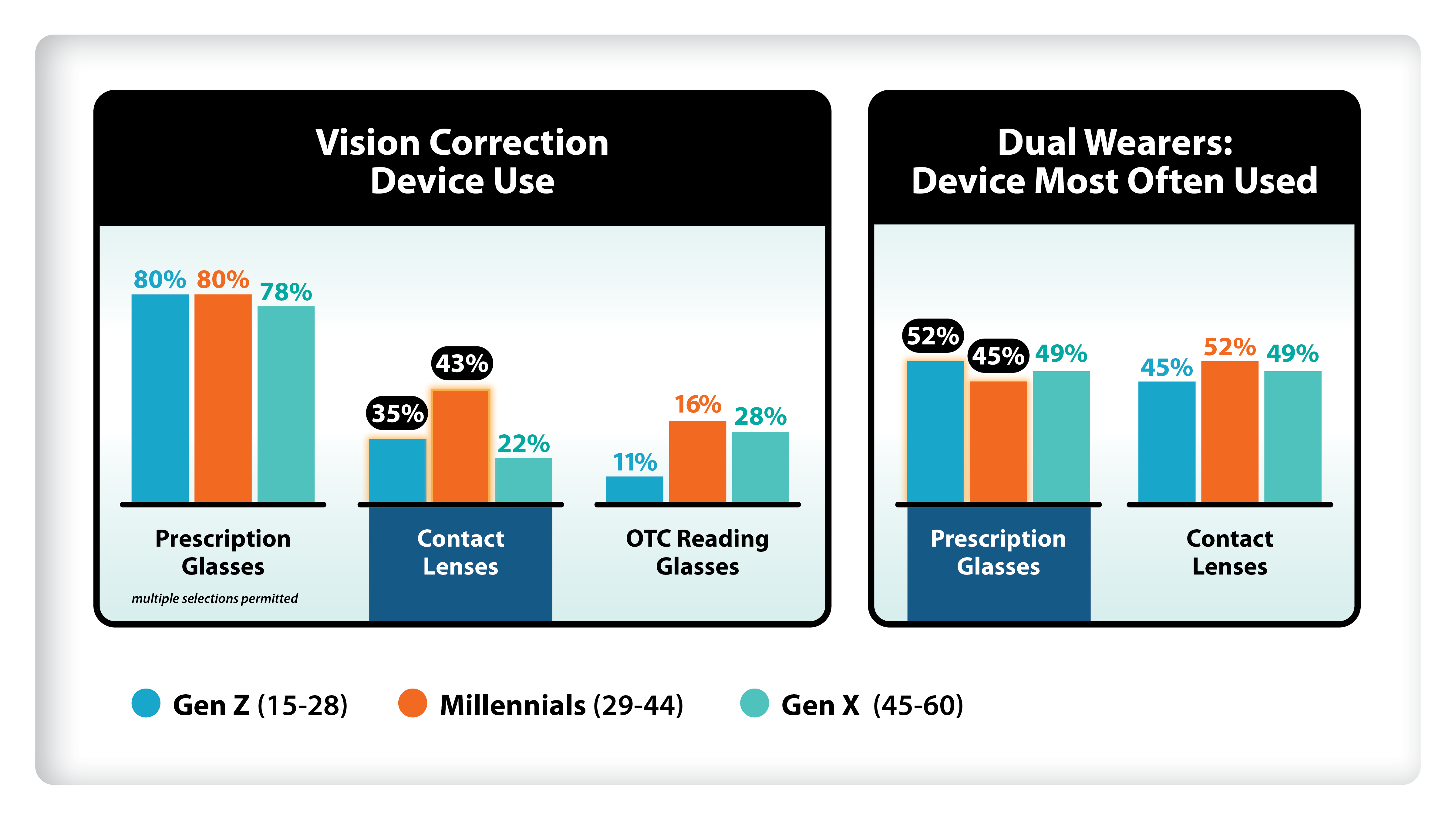
Dual wearers, those who already embrace both modalities, offer a window into modern visual lifestyles. Their habits are dictated less by vision needs and more by situational preference. For instance, glasses were favoured when working from home or flying. Contact lenses, on the other hand, were preferred for workdays, physical activity, social outings, and even dating.

Dual wearers also reported a high degree of satisfaction. They described being able to “feel their best” (84%), match their vision correction to how their eyes felt each day (82%), and even pair their correction with their mood (60%). This illustrates how today’s patients view eyewear and lenses as part of a larger self-expression toolkit—not just a medical device.

Where ECPs Can Do More

Most patients continue to purchase their devices from their ECPs, suggesting a strong foundation of trust. However, this trust is undermined if patients don’t hear about all their options.

Too often, practitioners wait for the patient to ask about contact lenses or glasses. Meanwhile, patients assume that if something isn’t mentioned, they must not be a candidate.

Closing this communication gap is essential. Whether it’s offering an in-office trial pair of lenses, explaining that prescriptions can be used across modalities, or simply bringing up the subject, initiating the conversation makes a measurable difference.

Freedom to Choose

Dual wear isn’t just a fashion statement or a matter of convenience, it’s a patient-centered strategy that aligns with modern lifestyles. For ECPs, it also represents a missed opportunity if overlooked.

Today’s patients want options, control, and personalization. By embracing a mindset that encourages both glasses and contact lenses where appropriate, practitioners can boost satisfaction, improve outcomes, and strengthen loyalty.

Glasses and contact lenses aren’t in competition. When paired effectively, they’re the perfect team.

View the original article CRO Journal.

Mark Schaeffer, OD. FAAO

Dr. Mark Schaeffer, OD, FAAO

An optometrist by profession, educator by passion. Leveraging my training and expertise, I thrive on bridging the gap between healthcare and patient well-being. Whether it’s engaging in one-on-one consultations or addressing a room full of peers, my aim is to enhance eye care at every opportunity. Fortunate to be supported by an outstanding team and remarkable partners, I contribute to delivering innovative care in examination rooms, conference halls, boardrooms, and beyond.


Share:
Rate:

0 / 5. 0

Contact Lens Drop Outs

New research highlights the role of every staff member in improving satisfaction and retention

A newly published article in Clinical & Refractive Optometry (CRO) Journal sheds light on a persistent issue in the eye care profession—contact lens dropout. Despite advances in lens technology and patient education, nearly one in four new contact lens wearers discontinue use within their first year. The study, commissioned by the Contact Lens Institute and conducted by Prodege, surveyed 401 adults to identify factors that influence whether patients stick with—or give up on—contact lenses.

This peer-reviewed article, authored by Dr. Shalu Pal, is also available as a 1-hour accredited CE course at CROJournal.com, the online education platform from CRO Journal.

Satisfaction Gaps: A Call to Action

The study revealed a significant 19-point satisfaction gap between new wearers (67%) and long-term users (86%). This signals an opportunity for clinics to enhance the early experience of contact lens patients, with comfort, visual quality, and convenience emerging as key drivers of satisfaction.

On the flip side, dissatisfaction stemmed largely from cost, handling difficulties, and visual discomfort—factors that new wearers were particularly sensitive to.

The Power of the Entire Practice Team

One of the most compelling findings is the influence of the whole eye care team—not just the optometrist—on new wearers’ decisions to continue with lenses. From administrative staff to technicians and opticians, every interaction mattered.

In fact, 74% of new wearers said their eye doctor played a significant role in their decision to stick with contact lenses, compared to just 59% of long-term wearers. Opticians, optical staff, and front-desk teams were also seen as more influential by newer patients, reinforcing the importance of a team-based approach to patient care.

Targeted Strategies for Retention

The study outlines several actionable steps practices can take to reduce Contact Lens dropout:

  • Cost Conversations: New wearers were especially receptive to clear explanations of pricing, alternative lens options, and rebate availability.

  • Handling Support: Quick in-person or virtual follow-ups, extra training sessions, and selecting lenses with better handling characteristics were all effective.

  • Comfort and Vision Concerns: Listening to concerns, offering reassurance, and scheduling proactive check-ins ranked among the most valued actions by patients.

Proactive communication and personalized education were identified as critical tools in retaining new wearers and boosting long-term satisfaction.

Compliance Trends and Lifestyle Fit

Interestingly, 74% of new wearers said they followed their provider’s lens replacement schedule, compared to 65% of long-term wearers—suggesting that ongoing reinforcement of healthy habits is essential over time.

The study also emphasized the importance of lifestyle-centered prescribing. Patients were more likely to continue lens use if they believed it improved their lifestyle—offering freedom from glasses, better comfort, and visual confidence. For example, individuals using screens extensively or engaging in sports may benefit from specific lens types tailored to their needs.

Practice Implications

This study challenges the notion that dropout is inevitable. With a coordinated effort across the entire practice team and strategies designed to proactively address patient concerns, clinics can make a tangible difference.

Dr. Pal encourages clinics to re-evaluate how they train and empower every staff member to play a role in retention. From first impressions at reception to post-exam follow-ups, small changes can yield big results in turning new wearers into lifelong contact lens patients.

Take the Course

For eye care professionals interested in diving deeper, the full article, Disrupting Contact Lens Dropout: Practice-Centered Factors That Influence Continued Wear, is available as a 1-hour COPE-accredited CE course at www.crojournal.com.

By turning insights into action, your practice can not only reduce dropout but also build stronger, more loyal patient relationships.


Share:
Rate:

0 / 5. 0

If you are anything like me you probably can’t imagine a world without some form of vision correction – whether it be glasses, contact lenses or even refractive surgery. Personally, I have been wearing glasses for myopia since the fourth grade. I didn’t realize I had a problem with my distance vision until my first eye exam; this was the first time I could literally “see” the difference placing a plastic lens in front of my eyes could have on my perception of the world.

Refractive error, as it pertains to the human eye, describes an aberration in the visual system that produces unclear or blurred images. There are many types of aberrations that may occur in one’s visual system and traditional lenses are limited in the degree and type of aberrations which they can correct. Additionally, disease, infection or functional abnormalities may also affect visual acuity and are important aspects to investigate if one’s vision is poor.

Today it is easy to undergo an eye exam and obtain spectacle lenses to correct for one’s own unique visual impairments. With the use of the phoropter and a systematic methodology combining both objective and subjective data, an optometrist can diagnose their patient’s refractive error with great accuracy in a relatively short period of time. This methodological process is termed Refraction, and is best described as both a science and art.

Refraction is Both Science and Art

The science of refraction involves the ways in which a lens placed in front of the eye may alter the quality of the images produced by the brain. The art of refraction involves providing a patient with a prescription that considers their specific and unique visual issues and aids in improving their vision by correcting for those unique issues.

In most Provinces and Territories, the ability to perform refraction is limited to optometrists, refracting medical doctors and ophthalmologists. However, many opticianry school programs have begun to incorporate both theory classes as well as practical training in Refraction into their programs. The inclusion of such classes will help increase the depth of understanding in dispensing, visual optics and the physiological functioning of the eye among new opticians, while additionally providing novel avenues for potential revenue; especially if there is a change in the opticians’ scope of practice in more Provinces, allowing for stand-alone vision tests similar to British Columbia and Alberta.

Outside of vision testing, knowledge of Refraction may be beneficial to opticians who perform contact lens fittings. A sound knowledge of refractive methodology will make sphero – cylindrical over refraction (SCOR) an easier task and allow the optician who performs it to combat poor acuity, the second most common reason for contact lens drop out, next to comfort, in new wearers. As most practitioners, opticians and optometrists alike, tend to mask astigmatism with a compensated spherical contact lens prescription, those who correct for it, or at least present it as an option to patients will see an increase in both fits and sales.

Astigmatic Correction Often Provides a Noticeable Difference

Arguably it does take time to perform a thorough and complete contact lens fitting with sphero – cylindrical over refraction; as such, it is reasonable to charge a contact lens fitting fee depending on complexity of the fit.

Investing in this process however indicates to your customers a higher level of professionalism and helps build loyalty. Offering contact lens options shows the customer your versatility in fits and demonstrates your concern for their vision quality. Extending contact lens fit over multiple visits to allow for trial lens comparisons is recommended, and the ultimate in interactive patient feedback in healthcare.

Depending on one’s prescription, providing astigmatic correction often provides a noticeable difference in vision quality. Becoming familiar with the lenses that work best for you and your customer demographic will be essential in determining which contact lens manufacturer fit sets you should keep at your location. Having a fitting set onsite reinforces the professionalism and quality of an establishment, given the perception among the public of astigmatism correcting lenses as premium products. Space concerns may limit the fit sets you may be able to keep so reviewing previous sales data is a good starting point.

Paramount in contact lens fitting is setting reasonable patient expectations based on spectacle visual acuity. Achieving a good fit with a toric lens and demonstrating visual acuity enhancement employing the knowledge of Refraction, while performing sphero-cylindrical over refraction, will result in a stronger customer base, greater sales and increased profits.

Dr. Shaun Rawana

Dr. Shaun Rawana is a practicing optometrist with over 15 years of experience in both the United States and Canada. His area of focus has been primary care optometry with interests in cornea/ocular surface disease and contact lenses. Dr. Rawana recently began teaching clinical skills in the Opticianry program at Seneca College and looks forward to contributing his insights into the current Canadian scene through Optik.


Share:
Rate:

0 / 5. 0

Contact Lens pricing

By Dr. Trevor Miranda. 

Dr. Miranda contributes his thoughts and perspectives on the topic of Independent Eye Care Practice in Eye Care Business Canada. Check out all of Dr. Miranda’s articles in Independent Insights category.

The modern consumer is egocentric. By that, I mean that they generally make purchases based on what is best for them, not what is best for the retailer.

A wise Optical Owner once told me that I wasn’t magic! How dare he dash my dreams of one day becoming a magician?! “You can’t make people buy from you.” He continued, “people will buy if they think it’s in their best interest to buy from you, so go ahead and take your shot by making your pitch.”

The Current Reality

 Today’s contact lens consumer is bombarded with online offers to purchase contact lenses directly. Clearly Contacts and other online retailers invest heavily to attract your contact lens patient into their online channel. At Kits, the online retailer’s fastest growing retail segment is a contact lens subscription that is taking your patient out of your purchasing channel for an average of 10 years (extrapolated based on European stats). Canadian studies have shown that a contact lens patient makes 2.9 purchases per year. Is this consumer using their friendly neighbourhood ECP, a convenient Big Box store, or online retailer to fulfill these purchases? Another industry statistic shows that less than 25% of patients in an optometrist office purchase annual supplies of contact lenses and the redemption rate of massive consumer rebates is less than 50%.

Contact Lens Pricing Strategies:

The Annual Supply: Many contact lens companies offer rebates and train our teams to recommend annual supplies of contact lenses. This allows the consumer to tap into “the lowest price after rebate.” There are quite a few flaws in this strategy:

  1. Most patients do not require or want to buy an annual supply of contacts.
  2. Rebates are a hassle factor and are not universally redeemed. The sticker price is artificially high and can be a shock and disincentive to purchase, rebates also require the patient to do some math to figure out if it is a “good deal” or not.
  3. Many Optometrists are compensated on a percentage of gross sales basis. The inflated price is overly expensive to the clinic owners, as that initial higher dollar amount paid potentially reduces overall profitability to the clinic.
  4. The rebates change, often quarterly, and the office staff needs to constantly update price quote sheets to keep up to date pricing.
  5. Pricing is often tiered so smaller purchase increments are not competitively priced

Per Box Pricing: The easiest way for a consumer to understand and compare pricing is on a per box basis. It is challenging for ECPs to flat price per box because of better incentives to sell larger amounts resulting in better pricing to the owners and thus better profit margins. There are, however, ways to implement this strategy in a way that is staff and consumer friendly:

  1. Negotiate with your Contact Lens Manufacturers for instant rebates or no rebates with better wholesale pricing on the lenses.
  2. Consider a small contact lens inventory where you buy “smartly” in increments that give you the best pricing and thus enabling flat per box pricing without reducing your margins.

Subscription: Studies have shown that many Canadians view contact lenses as an unaffordable luxury purchase. The sticker price keeps them from taking the plunge into full time contact lens wear. The world has moved to subscription: Services such as Netflix, gym memberships, wine clubs and, I have even heard of subscription toilet paper, are now the norm and accepted by the modern-day consumer. This allows contacts lens purchases to be considerd as “sunk costs” thus making available money to purchase other items such as sunglasses or mulitple pairs of glasses. Here are some advantages of subscription contact lenses:

  1. Affordable consistent monthly payments that reduce sticker shock
  2. The ability to consolidate a receipt to tap into insurance coverage
  3. Auto-preparation for rebate submissions.
  4. “Stickiness factor” – On average a patient stays on contact lens subscriptions for 9.9 years in Europe.

Web Stores: The pandemic drove many ECPs to develop an e-commerce strategy. While allowing the convenience of shopping at your clinic/store 24/7 is great, it has also led to some unintended consequences for some offices. Here are some e-commerce tips:

  1. Your online store offering should mirror your in-office offering. If you offer a sale online ensure you promote it in store.
  2. Inform your current patients of this convenience. Unless you spend money to elevate your search ranking, the bigger online players will  appear first.. You might be unwittingly pushing your patient to be crawled by bots on the internet and potentially taken out of your channels by Clearly and other online players.
  3. Make it easy to navigate and order online.
  4. Offer direct to patient delivery. Many manufacturers are still offering free delivery.

The Secret Sauce:

Keys to Successful Contact lens Sales:

 The doctors and ECPs need to approve the wearing of fitted contact lenses. Let the patient know that you have great pricing on contact lenses before the hand off to the optician or dispenser. A confident word from the doctor that buying from your practice really goes a long way and is in the best interest of the patient.

  1. Ensure that per box pricing is competitive. Be aware that patients will Google the brand and immediately compare pricing  from online retailers.
  2. Consider fitting brands that are ECP exclusive or “channel protected”
  3. Partner with manufacturers that give you the best margins while also making future purchases from your office more likely.
  4. Everyone approved for contact lenses should leave with a contact lens quote even if they are determined to buy from another source. The quote should include a per box price and a per month subscription price.

Good luck prescribing contact lenses and retaining your patients!


2024 Trevor Miranda

DR. TREVOR MIRANDA

Dr. Miranda is a partner in a multi-doctor, five-location practice on Vancouver Island.

He is a strong advocate for true Independent Optometry.

As a serial entrepreneur, Trevor is constantly testing different patient care and business models at his various locations. Many of these have turned out to be quite successful, to the point where many of his colleagues have adopted them into their own practices. His latest project is the Optometry Unleashed podcast.


Share:
Rate:

0 / 5. 0

Dr. James (Jim) Hoffman, shares insights on how to get former contact lens patients with presbyopia and astigmatism back into contacts and WOW them them in the process with new ULTRA Multifocal for Presbyopia from B + L.


About the Guest

Dr. Jim Hoffman graduated from the University of Houston College of Optometry in 1981 and was awarded fellowship in the American Academy of Optometry in 1985. Dr. Hoffman excels in pediatrics and advanced contact lenses and often lectures to his peers in USA and Canada.

Dr Hoffman is an independent practice owner with two practices in Orange Park Florida (south of Jacksonville), where he practices with his wife Dr. Karen Larson.


Episode Notes

Dr. James (Jim) Hoffman, enthusiastically shares insights on how to get former contact lens patients with presbyopia and astigmatism back into contacts and WOW them with new Bausch + Lomb ULTRA Multifocal for Astigmatism.

While multifocal toric contact lenses have been around for some time, the combination of a contact lens for presbyopia and  astigmatism in a stable, easy to fit format has been an unmet need for both practitioners and patients.

In the past Dr. Hoffman acknowledged that he had reluctantly informed patients, “there’s no contact lens for you” that could satisfy both their desire for uncompromised vision and freedom from glasses.

As an early adopter of Bausch + Lomb ULTRA Multifocal for Astigmatism contact lenses, Dr. Hoffman shares tips on how to bring back astigmatic presbyopes that had given up on contacts.

In this podcast Dr. Hoffman shares in detail:

  • how his office prepares specifically for these patients,
  • his in-office protocol,
  • patient communication strategies, and
  • follow up protocol.

Until the availability of this new lens he hadn’t realized just how frustrated the patients were. He and his patients now have the satisfaction of returning to contact lenses and regaining freedom from glasses without compromise to vision.

Key Tip: Since there’s never been a contact lens like this, he stresses the importance of following the Fitting Guide.

Resources


Dr. Glen Chiasson

Dr. Glen Chiasson

Dr. Glen Chiasson is a 1995 graduate of the University of Waterloo School of Optometry. He owns and manages two practices in Toronto. In 2009, he co-hosted a podcast produced for colleagues in eye care, the “International Optometry Podcast”. He is a moderator of the Canadian Optometry Group, an email forum for Canadian optometrists. As  a host of  “Eyes Wide Open”, Glenn  looks forward to exploring new new technologies and services for eye care professionals.

Dr. Chiasson enjoys tennis, hockey, and reading. He lives in Toronto with his wife and two sons.

Dr. Chiasson splits EWO podcast hosting duties with Roxanne Arnal.


Share:
Rate:

0 / 5. 0

By Jaclyn Chang, OD

Residency trained optometrist Dr. Rosa Yang shares her knowledge on the ever-changing topic of specialty contact lenses in the following conversation with NewOptometrist.ca editor, Dr. Jaclyn Chang.

Dr. Rosa Yang

Jaclyn: What are the indications for scleral lens use?

Rosa: Scleral lens use has been growing and gaining more attention in recent years. The scleral lens vaults over the cornea and has increased comfort.

Previously, the primary indication for scleral lenses was corneal ectasia; the main one being keratoconus. Now we have learned about other benefits of scleral lenses, for example, patients with dry eye. Scleral lenses provide constant lubrication to the ocular surface. While dry eye is a multifactorial disease and scleral lenses aren’t for every patient with dry eye, there is a specific subgroup of patients who would benefit from them. These include patients with exposure, such as with a facial palsy.

Jaclyn: What equipment is necessary for fitting specialty contact lenses?

Rosa:  Topography is essential to the fitting of specialty contact lenses. When you think about managing glaucoma, you think about how important OCT is to glaucoma specialists. The analogy for a contact lens fitter is topography.

It is an effective method to assess ortho-K treatment, for example. While the patient may have optimal vision and the lens may appear well-fitted open-eye, this may not always correlate with optimal ortho-K treatment overnight. The treatment may be decentered but provides enough treatment through the optical center to give good vision. However, this does not equate to optimal treatment.

There is also value in topography with scleral lens fits. The amount of time needed to select the initial lens can be minimized. The topography can aid us in determining the initial sag of the lens. We have also learned that many scleras have toricity. Some topographers can map out scleral contour to help us decide if the patient would benefit from a toric peripheral design.

Jaclyn:  Can you talk a little bit about specialty soft contact lenses?

Rosa:   Sure, there are specialty or customized soft contact lenses for high prescriptions outside of range. For example, I had a patient whose prescription was -22D. We put this patient in a soft contact lens called Intelliwave. Keep in mind that this lens lasts for three months so the patient has to be diligent with cleaning.

Jaclyn: What is new in the world of fitting specialty contact lenses?

Rosa:  Profilometry is fairly new. With this, the topographer and the software are linked to the contact lens manufacturer. Normally, we would do a diagnostic fit, where you put a lens on the eye, check the fit, and then specify the change in parameters. Profilometry is a method in which the contact lens manufacturer can generate a lens with a specific parameter based on the topography itself.

Aberrometer is also a relatively new technology being implemented. Higher order aberrations (HOAs) can lower best corrected VA and quality of vision. HOAs can be measured and neutralized to improve vision in scleral lens wearers.

Jaclyn:  Great, thanks so much for that refresher and update!


Previous discussions with Dr. Rosa Yang: 

Perspectives on Myopia Control
Pursuing a Contact Lens Residency

JACLYN CHANG, OD

Editor NewOptometrist.ca

Dr. Jaclyn Chang graduated from the University of Waterloo (UW) with an Honours Bachelor of Science in Biomedical Sciences before continuing at Waterloo to complete her Doctor of Optometry degree. She is currently a practicing optometrist in Toronto.

Dr. Chang is committed to sharing information and bringing new resources to her colleagues. As a student, she sat on the Board of Trustees for the American Optometric Student Association, organizing events to connect students with industry. She was the Co-Founder/Co-President of the award-winning UW Advancement of Independent Optometry Club, the first club at UW dedicated to private practice optometry. Dr. Chang is also a passionate writer, who aims to make information accessible and easily digestible to her colleagues. She has published in Optometry & Vision Science and Foresight magazine and contributed to Optik magazine. She is excited to bring valuable resources to Canada’s next generation of optometrists with NewOptometrist.ca.


Share:
Rate:

0 / 5. 0

Dr. Jocelyn Leung is passionate about contact lenses. Here she discusses how she implements multifocal contact lenses into her everyday practice to provide patients with vision that fits their lifestyle.

Jaclyn:  How do you identify successful candidates for multifocal contacts?

Jocelyn: Once patients reach presbyopia, possibly getting eyestrain and headaches, you can have the conversation about multifocals.

If the patient is already a contact lens wearer, fantastic. Patients who wear contact lenses are used to not wearing glasses and want to maintain this lifestyle. Glasses are inconvenient for any athletic activity, traveling, especially nowadays with the masks causing constant fogging!

I discuss the options with the patient: glasses over contacts, monovision, or multifocal contact lenses.
Before a multifocal fitting, I set expectations and let the patients know that they won’t necessarily have 100% clarity of vision but will get convenience. I usually say that they can achieve about 80-90% of what they would be able to see with glasses and gauge the patient’s response.

Patients who prioritize convenience over perfect vision are ideal candidates. It is important to make sure that the patient understands the way multifocal lenses work and what is optically possible.

Jaclyn: How is the conversation different if the patient is not a previous contact lens wearer?

Jocelyn:  Multifocal contact lenses are a good option for presbyopic patients whose end goal is to be glasses free, even if they have not previously worn contact lenses. The process does take a little bit more time, with teaching insertion and removal and educating on contact lens hygiene.

It really depends on the patient’s personality and visual demands. Last week, I fit a patient who has never worn contact lenses but did not want to wear glasses anymore due to the mask and fogging. She was very, very happy with her lenses right off the bat and I finalized her prescription with only one more visit.

Jaclyn: Can you walk us through your process of fitting multifocal lenses?

Jocelyn: I first discuss the process and fitting fees with the patient. On average it is going to take three visits and some time to find the right prescription. I let the patient know that it’s very likely they won’t be fit on the first try, and then if they are fit earlier, they’re even happier.

I look at the prescription and what lenses the patient has worn in the past. Using a brand or modality similar to what they’re currently wearing can help ease the transition. I usually stick with DAILIES TOTAL1 as my number one go-to option for multifocal lenses.

The fitting guide, which is individual to every brand and contact lens, is very important. My tip is to find two or three multifocal lenses that you like and memorize those fitting guides. Then if you need to pivot, you can look up the fitting guide for the other tertiary lenses.

Grab your first trial lens and have the patient try the lenses on in the office. It does take some time for the lens to settle and for the patient’s brain to adjust, so let the patient know that you do not expect perfect vision right now.

Make sure that the patient is functional before they leave the office: meeting the driving standards, comfortable seeing far away, and can read their phone. Then you can send them home with some lenses.

I do a one week follow up, but the patient can take two to four weeks to adapt. I like to see the patient at least every week, maximum two weeks, for a follow up to get their feedback. Otherwise, the patient may try the lens, forget about their vision, and not be able to provide you with comments. If there’s something the patient isn’t happy with, they need to vocalize that to you. You need to ask the right questions and be able to adjust from there.

At the first follow-up appointment, I get feedback on the comfort and vision at distance, intermediate, and near. I do use a reading card for a metric number at near, but I do not base my success on a number. I am not aiming for a certain visual acuity. I am aiming for what the patient is happy with because everyone has different visual demands.

We see if the patient wants to improve their distance or near vision and make sure that the comfort of the lens is good. We can then do an over-refraction to see what adjustments need to be made.

After a few appointments, if we find a lens that the patient is happy with, we can finalize the prescription. If the patient still is not getting comfortable vision, we can give it another shot for a few more weeks before switching to monovision or back to glasses if necessary.

Jaclyn: Can you give us some insight into your discussion on fitting fees with the patient?

Jocelyn: I always discuss fees first so there are no surprises. If financials are a deciding factor, then we only discuss options within their absolute cutoff budget.

We can always educate and bring awareness to our patients on the options available. However, if the patient is very happy with over-the-counter readers or taking their glasses off to read, they likely won’t be convinced to try multifocals. It’s what they’re used to and that’s what they’re happy with. To try multifocal lenses, you have to be enthusiastic and engaged in the process.

If the patient is willing to give multifocals a try, that’s when we can add the most value. I’ll explain that a contact lens fitting is a process, and the fitting fee is a one-time fee that covers trial lenses and multiple appointments.

As long as the patient understands that we are putting in the effort to try to get them the best vision possible, they will be more open to that fitting fee. Depending on the clinic, fitting fees may also cover appointments for any sort of infections or emergencies related to contact lenses. This gives the patient reassurance that we’re going to be there every step of the way.

Jaclyn: Great, thank you so much for all your tips on being more successful with our multifocal fits!

JACLYN CHANG, OD

Editor NewOptometrist.ca

Dr. Jaclyn Chang graduated from the University of Waterloo (UW) with an Honours Bachelor of Science in Biomedical Sciences before continuing at Waterloo to complete her Doctor of Optometry degree. She is currently a practicing optometrist in Toronto.

Dr. Chang is committed to sharing information and bringing new resources to her colleagues. As a student, she sat on the Board of Trustees for the American Optometric Student Association, organizing events to connect students with industry. She was the Co-Founder/Co-President of the award-winning UW Advancement of Independent Optometry Club, the first club at UW dedicated to private practice optometry. Dr. Chang is also a passionate writer, who aims to make information accessible and easily digestible to her colleagues. She has published in Optometry & Vision Science and Foresight magazine and contributed to Optik magazine. She is excited to bring valuable resources to Canada’s next generation of optometrists with NewOptometrist.ca.


Share:
Rate:

0 / 5. 0

By Jaclyn Chang, OD

I recently had the chance to discuss how myopic control can benefit our patients with contact lens residency trained optometrist, Dr. Rosa Yang.

Here is the conversation.

Dr. Rosa Yang

Dr. Yang pursued a post-graduate residency program in Cornea and Contact Lenses at the University of Waterloo.

She is the recipient of the Sheldon Wechsler Contact Lens Residency Award from the American Academy of Optometry and was awarded First Place in Clinical Poster from the Global Specialty Lens Symposium.

Dr. Yang has particular interests in myopia control (including ortho-K), dry eye and corneal disease management.


Jaclyn:  What myopia control options are available?

Rosa:  There are several options including the MiYOSMART spectacle lenses by Hoya, MiSight soft contact lenses or off-label use of soft multifocals, Atropine, and ortho-K.

As a clinician, I think it is good to be aware of all the options so you can choose the most appropriate option for your patient.

Jaclyn: How do you choose one myopia control option over another for a patient? Is it very individual to that patient’s comfort level and particular case?  

Rosa: I don’t want to oversimplify, but, yes, there are selection criteria where we weigh one option over another. These include prescription, the parents’ budget, and the underlying eye condition.

A big factor is also how comfortable the patient is with handling contact lenses. Do they want to handle the contacts themselves or is it something that the parents might want to be more involved with? For the latter, ortho-K might be the better option because it’s mainly done at home at night.

For a patient who doesn’t want to wear hard contact lenses or glasses, and if the parents are hesitant about putting their kids on a medication (Atropine), soft contact lenses are the option we would be considering.

The only FDA approved soft contact lens for myopia control is MiSight, but it is limited by the fact that it is not available with astigmatism. In patients who have astigmatism, multifocal soft contact lenses can be used to implement the peripheral defocus effects.

Jaclyn: Under what circumstances might you select specifically designed spectacle lenses (like  MiYOSMART) for the patient?

Rosa: Some patients have been wearing spectacles and would like to continue wearing them. For them, it makes sense to keep them in myopia control lenses like MiYOSMART.

There are also patients who are uncomfortable pursuing contact lenses (i.e. they have trouble handling CLs, they are poor CL candidates) or the parents are uncomfortable having their kids on long-term atropine drops, then we would consider spectacles.

MiyoSmart lenses may also have larger prescription ranges than the contact lenses.

Jaclyn: When would you initiate myopia control treatment? Do you monitor until you see progression or initiate at the onset of myopia?

Rosa: Currently there is no consensus amongst clinicians, but when I see evidence of fast progression, then I initiate myopia control. Average progression is -0.50D per year, so anything above that might urge me to start myopia control; sometimes you may want to monitor a little bit more to see.

There are also clinicians that see myopia control as a preventative treatment that should be used more widely, especially considering the global myopia pandemic, so it’s a grey area.

Jaclyn: Are there certain things that we can say to our patients to help them better understand the importance and benefit of myopia control treatment? How can we help them understand the health implications associated with myopia?

Rosa: This is a very good question, because this is a topic that I discuss with every parent when we talk about myopia control. I tell them that the reason we pursue myopia control is not just the high prescription itself, it’s not just the inconvenience of having really thick glasses, it’s the ocular health implication.

“When you have a high prescription, the eyeball is usually more elongated, which means that the tissues in the eyeball get stretched out and are thinner; this predisposes them to certain ocular health complications, some of which are vision threatening. There is a higher risk of retinal detachment, maculopathy, and glaucoma.”

When I emphasize this, parents usually understand. With myopia control, it’s very important that parents understand what you’re doing, why you’re doing it, and how you’re doing it.

Jaclyn: Thanks for that – hearing the way that other doctors counsel always helps me with how I counsel my patients. Education makes such a big difference to patient care. 

Rosa: Yes, exactly, with myopia control, sometimes parents wonder why their child’s prescription still increases. That’s why with myopia control, it’s very important to have a consultation.

The management we’re doing is not to stop myopia, it’s to slow down the progression of myopia; regardless, the child is still going to progress.

Another thing to realize, for example, with ortho-K, is that some parents may think that once you wear the ortho-K lenses, that the prescription is completely gone, so explaining the process and treatment is very important.

Jaclyn: Thank you so much Dr. Yang! This gives our audience some things to think about and implement into everyday practice. 

Previous discussions with Dr. Rosa Yang: 
Pursuing a Contact Lens Residency: 

JACLYN CHANG, OD

Editor NewOptometrist.ca

Dr. Jaclyn Chang graduated from the University of Waterloo (UW) with an Honours Bachelor of Science in Biomedical Sciences before continuing at Waterloo to complete her Doctor of Optometry degree. She is currently a practicing optometrist in Toronto.

Dr. Chang is committed to sharing information and bringing new resources to her colleagues. As a student, she sat on the Board of Trustees for the American Optometric Student Association, organizing events to connect students with industry. She was the Co-Founder/Co-President of the award-winning UW Advancement of Independent Optometry Club, the first club at UW dedicated to private practice optometry. Dr. Chang is also a passionate writer, who aims to make information accessible and easily digestible to her colleagues. She has published in Optometry & Vision Science and Foresight magazine and contributed to Optik magazine. She is excited to bring valuable resources to Canada’s next generation of optometrists with NewOptometrist.ca.


Share:
Rate:

0 / 5. 0