

Artificial intelligence is quickly moving from experimentation into everyday health care workflows, and optometry is no exception. In the webinar AI Trends in Optometry: Cut Through the Noise, Dr. Abdullah Sarhan and Maryam Moharib delivered a direct message to Canadian optometrists: AI is no longer something to watch from the sidelines. It is becoming a core part of clinical practice, administrative efficiency and the future delivery of eye care.
Their central point was clear: AI will not replace optometrists. However, optometrists who learn how to use AI effectively may be better positioned to enhance patient care, reduce administrative burden, improve clinical workflows and strengthen their role as health professionals. View the entire presentation.
Optometry – Made for AI
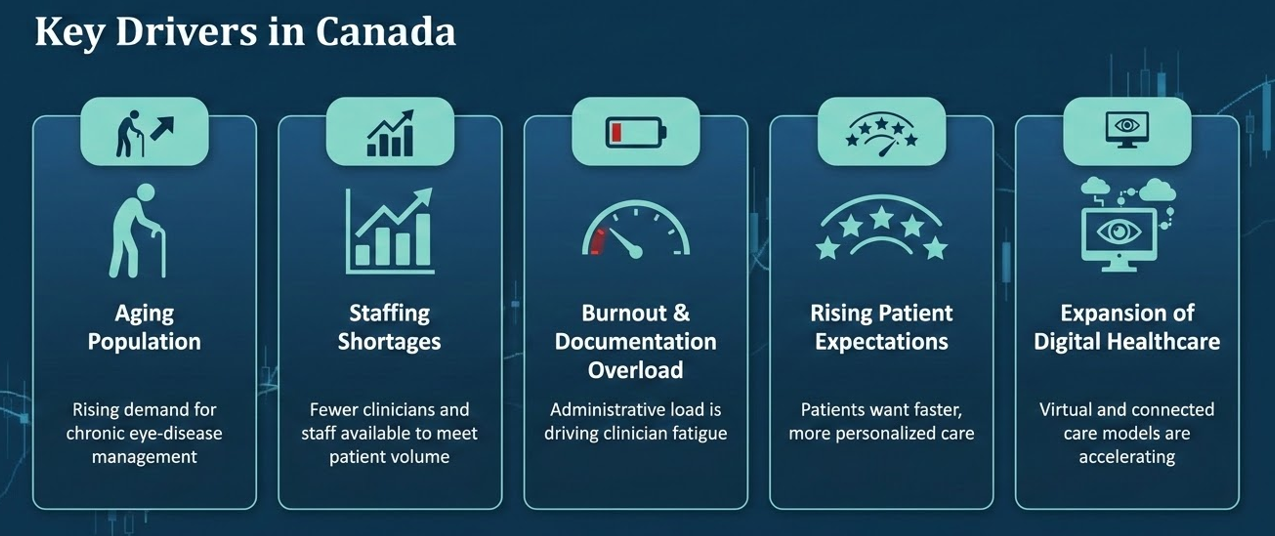
The presenters began by outlining why optometry is particularly well suited for AI adoption. The profession relies heavily on imaging, structured clinical data, repeated measurements and longitudinal patient records. At the same time, many practices face staffing shortages, documentation fatigue, burnout, rising patient expectations and increasing pressure to operate more efficiently.
A major focus of the session was the rapid development of AI-assisted diagnostics and retinal imaging. Current and emerging applications include diabetic retinopathy screening, AMD detection, glaucoma risk analysis, OCT interpretation, retinal image grading and disease progression monitoring. The presenters also addressed the growing field of predictive eye analytics, including the concept of oculomics, where retinal imaging may help identify broader systemic health risks.
This has important implications for the future role of optometrists. As AI tools become more advanced, optometrists may play a larger role in preventive health, early detection and collaborative care. Rather than narrowing the scope of practice, AI may help expand the profession’s contribution to systemic disease detection and patient management.
The webinar also explored generative AI and workflow automation. Examples included AI-generated SOAP notes, referral letters, patient education summaries, clinical documentation support, voice agents and ambient AI scribes. These tools have the potential to reduce charting time, increase patient-facing time and support more consistent documentation — provided they are implemented carefully and remain under clinician supervision.
AI Enhanced EHR Systems.
Another key theme was the evolution of optometry EMRs. The presenters described a shift from EMRs as simple “systems of record” toward more intelligent platforms that can support documentation, clinical recommendations, care gap alerts, risk stratification, follow-up reminders, imaging integration, billing, recall management and business optimization.
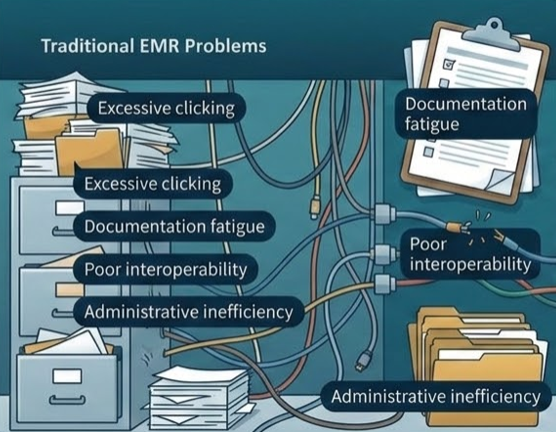 However, the session was not a blanket endorsement of every AI tool entering the market. The presenters emphasized the need for critical evaluation. Practices considering AI-enhanced tools should look closely at the quality of the clinical evidence, reported performance metrics, regulatory considerations, Canadian privacy requirements, interoperability, vendor transparency, data storage, model training practices and safeguards for AI-generated content.
The presenters also addressed clinical and ethical risks, including hallucinations, false positives, false negatives, automation bias and over-reliance on technology. Their recommendation was straightforward: AI should support clinical judgment, not replace it. The most appropriate framing is “AI-assisted care” or “clinician-supervised AI.”
For practices considering adoption, the webinar offered a practical value checklist. Early adoption opportunities may include ambient AI scribes, automated recalls, AI-assisted imaging analysis and patient communication tools. These areas may offer lower clinical risk, faster return on investment and easier staff adoption. The presenters recommended pilot projects, incremental rollout, clear governance policies, staff training and measurable ROI indicators such as reduced charting time, increased efficiency, improved patient satisfaction and reduced burnout.
Looking ahead, the presenters suggested that AI-assisted screening, predictive analytics, voice-first charting, administrative automation and real-time clinical copilots may become routine elements of optometric practice by 2030.
The takeaway was direct but constructive: AI is part of the future of optometry. The choice for practices is not whether the technology will arrive, but how thoughtfully and effectively they will adapt.
View the entire insightful presentation on YouTube.