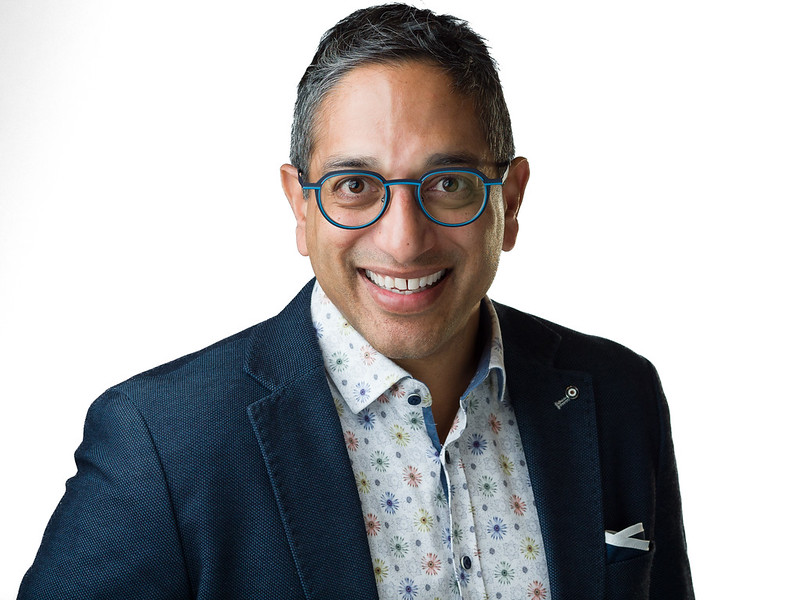


Dr. Sandra Chiu at Lake Views Eye Care – independent optometry clinic in Port Elgin

After graduating as New England College of Optometry’s valedictorian in 2014, Dr. Sandra Chiu moved back to her hometown of Toronto. She assumed her path would look more or less like everyone else’s: a mix of corporate shifts, a crowded schedule, and enough stability to make a dent in the student loans that had shaped so many of her decisions. Ownership wasn’t on the horizon; it wasn’t even on the table.

It meant working across multiple corporate side-by-side practices (two locations downtown and another in Mississauga) before eventually settling into a long-established uptown clinic with multiple lanes and a steady patient flow. The hours grew from two days a week to four and a half, giving her the full schedule she’d been chasing. She found a rhythm—a workflow that was steady and predictable.

But predictability has an odd way of revealing what’s missing…

In Sandra’s case, it took years of reliable days—patients, lunch breaks, commutes, repeat—before she noticed that reliability had flattened into something else. “It was like I was having the same day over and over again,” she says. “I felt underestimulated.”

It wasn’t a single moment that pushed her away; it was the steady build-up of minor pressures and disconnection that changed the job into something she no longer recognized. That realization lingered long enough to prompt a harder question she’d been avoiding: was this the work she wanted to do, or just the work she happened to be doing?

A Pandemic Reframe, and the Way Forward

During the first months of the pandemic, when nearly everything shut down, Sandra experienced the same disorientation everyone did. But beneath the uncertainty surfaced an unexpected clarity about what her life actually required. “If I’m just going to go to work and go home and go to work and go home… I could do that from anywhere,” she says. “It doesn’t have to be Toronto, and it doesn’t have to be in this practice context.”

Suddenly, options she had once dismissed as impractical now looked, at minimum, worth reconsidering. Every option was suddenly on the table.

She looked at career paths outside optometry, exploring science roles, pharmaceutical roles, even the possibility of stepping away from clinical work altogether. Still, a quieter instinct kept drawing her back. She wanted to build something of her own.

As the primary breadwinner in her household, she couldn’t afford the slow-build trajectory of a cold start. A new clinic might take months or years to generate stable patient flow—time she simply didn’t have. She needed it to be profitable right away.

So she shifted her focus to something far more practical, a route many new grads never think to consider. Instead of building a clinic from zero, she searched for a business that already had momentum.

The search eventually led her to a long-established optical run by a husband-and-wife team in Port Elgin, Ontario—a small but growing community that, until now, she never would have pictured as home. But the numbers made sense and the patient base was solid. If she stepped in, she could pay herself from day one and build upward from there.

She purchased the establishment and gave it a new name: Lake Views Eye Care.

Where Textbooks End and Real Practice Begins

The experience presented her with a different kind of learning curve; one no amount of textbook training prepares new grads for. She shares, “Initially, I had zero knowledge of the dispensing side of things. I thought I knew, but I didn’t. I didn’t about the different lenses out there, what different designs mean, the different suppliers… like truly, truly zero.”

All of it belonged to a part of the profession she had never been asked to engage with in corporate settings. Thankfully, she wasn’t navigating it alone. As part of her purchase agreement, the previous owners stayed on for two months, giving her hands-on transition support and grounding her in the realities of optical operations before stepping back.

In addition, she bridged the experience gap by leaning on lens reps and consultants along with OSI’s one-on-one support and toolbox of resources. “All you have to do is ask questions,” she says. “You’re not alone.”

Reading the Momentum of a Growing Town

As her confidence grew, so did her sense of what was possible in a town whose population was expanding faster than its optometric services. Many new grads imagine rural work as a temporary compromise or a professional slowdown. Sandra saw the opposite.

Rural communities often offer the quickest path to autonomy (clinical, financial, and personal) because they hold unmet demand. In her case, unmet demand meant an opportunity to grow ahead of corporate chains that would eventually arrive.

Rather than waiting for a large retailer to establish a foothold, she moved first—putting everything in place to meet the needs of the community.

She found a new space, rebuilt it, and is now preparing to open a second location with two exam rooms.

Finding Clarity in the Numbers

Indeed, this kind of planning requires a strong grasp of one’s finances, something many young ODs feel unprepared to confront. Sandra doesn’t romanticize that reality, but she does refuse to let it dictate the limits of a career.

“Stop worrying about the big number,” she tells students who think that debt disqualifies them from making bold decisions. She encourages them to talk to a financial planner, calculate the monthly payment, and treat it like any other fixed expense, “like a car payment or phone bill.” Once the number is concrete rather than abstract, the overwhelm loosens.

That monthly number brings clarity, and with clarity comes room to think. Sandra encourages us to ask questions: “Are you practising optometry the way you want? How many weekends or evenings are you working? Will your employer mentor you? Will they market you? Do they want you to take over one day?”

Financial clarity gives structure to the earliest steps of a career, replacing desperation with discernment and helping new grads move toward roles that genuinely fit.

Paying it Forward

Now expanding, Sandra is preparing to open a second location with two exam rooms. The pace of growth has prompted her to think about the support that shaped her own transition. Wanting to give back, she now serves on the NECO alumni board and mentors students, inviting new grads to reach out when they feel stuck on next steps, curious about ownership, or unsure where independence fits into their plans.

For students and new grads, the through-line is simple: a willingness to ask questions and a habit of testing assumptions can turn a career from something that happens to you into something you shape purposefully. “Keep an open mind,” she reminds us. “Especially about rural optometry.”

OSI’s Role in Making Independence Possible

Much of Sandra’s transition was supported by OSI—its training resources, vendor relationships, consulting support, and the collective buying power that gives new owners room to breathe. OSI’s model reflects the same message Sandra shares with students: independence isn’t about doing everything alone; it’s about having a community that strengthens your decisions.

If you’re curious about private practice, buying a clinic, exploring rural opportunities, or simply figuring out your next steps, OSI Group can help you map the path. Your future and your freedom can all start with one conversation.

Start the conversation with us at info@opto.com — we’d be happy to connect.


Share:
Rate:

0 / 5. 0

OSI Group sponsored post- woman in front of a pond

For optometry students and recent grads, the default path can seem overwhelmingly urban. Big cities promise visibility and fast access to technology, but they also draw the same patients—and the same competition.

It’s a topic explored in depth on Future Focus. Sponsored by OSI Group, the podcast introduces students and new grads to the real-world decisions that shape a career in optometry. Each episode features candid conversations with practicing optometrists and offers practical insights on ownership, clinical growth, and finding your place in the profession.

In Episode 09, hosts Dr. Amrit Bilkhu and Dr. Alexa Hecht chat with OSI Member Dr. Amal Ahmed, owner of Beaumont Eye Clinic, about her journey from associate to practice owner in a thriving rural community.

Speaking candidly with the hosts, she reflects, “I didn’t want to open in a big city. There’s too much competition. When I found a practice in a growing community, I didn’t have to worry about saturation.”

The conversation surfaces key takeaways for young ODs: rural settings can speed the move into ownership and widen clinical scope, while also grounding a practice in relationships that grow deeper over time.

From Saturation to Opportunity

After completing her optometry training in the United Kingdom, Dr. Ahmed returned to Edmonton with plans to launch her career. Instead of opportunity, she found saturation. The city’s optical landscape was crowded, and every possible location already seemed spoken for.

Rather than force her way into a dense market, she began looking just beyond it—and discovered the Beaumont Eye Clinic. As an OSI Group member clinic, Beaumont offered not only a strong patient base but also access to the group’s shared resources, supplier programs, and professional network. Located 20 minutes outside Edmonton, the practice was well-established, with decades of patient records and a loyal base. It wasn’t flashy, but it offered a foundation she could build on.

Nurturing an Established Base

For more than three decades, the Beaumont Eye Clinic was guided by Dr. Bruce Mann, whose steady presence made the practice a fixture in the community. His reputation and long-standing relationships with patients meant that when Dr. Amal Ahmed stepped in, she inherited a history of trust. That foundation became the bedrock on which she could shape the next chapter.

The transition was handled with care. Dr. Mann remained on-site for a full year after the sale, a decision that reassured patients and allowed Dr. Ahmed to build familiarity without disrupting the rhythm of care. Patients could continue to see the doctor they had known while gradually getting to know the new one. For Dr. Ahmed, the overlap offered a rare chance to ease into ownership, observing the practice’s routines and listening to patients before deciding how to leave her mark.

Once those relationships felt secure, she began to introduce changes. The clinic’s layout was improved, new instrumentation added, and the office refreshed in stages. Each adjustment was paced to strengthen what patients already valued. The result was not a break from the past but a continuity—an evolution that honoured Dr. Mann’s legacy while positioning the clinic for the future.

Why Rural Practice Works

What Dr. Ahmed didn’t fully anticipate was how much rural practice would accelerate her professional growth.

In Beaumont, she took on more complex cases and became a trusted collaborator in the town’s healthcare network. With fewer specialists nearby, her scope expanded—sometimes out of necessity, sometimes out of trust.

She notes, “If you invest in rural communities, they invest back in you. My business has grown four to five times in three years, mostly through word of mouth.”

Financially, the advantages of owning property and operating with lower overhead gave her freedom to shape the business on her terms. Decisions could be made quickly, and new ideas tried without bureaucracy.

And on the human side, patients returned year after year, often bringing children or parents—creating long-term relationships that urban practices sometimes struggle to maintain.

Building a Specialty, Patient by Patient

Dr. Ahmed also saw opportunity in specialty care, especially for patients with dry eye disease. Instead of introducing high-tech solutions right away, she focused on creating demand before any major purchases. Educate first, invest second.

She began by offering test treatments and hosting information nights to give patients time to understand the service. By the time she introduced intense pulsed light (IPL) treatments, her patient base was ready.

“I didn’t just jump in with new technology,” she explains. “I took a year to build relationships, educate patients, and create a waitlist.”

Advice for Students and New Grads

For those still mapping out their next step, Dr. Ahmed recommends starting early—even if ownership feels far off.

She says, “Buying a practice could be a quick process or a slow one. Build the relationships right when you come out of school. Ask the right questions.”

That might mean reaching out to a clinic owner in a town you’ve never considered. It could mean shadowing someone over reading week or taking a short-term locum in a place that seems quiet on paper but turns out to be full of promise.

Indeed, not every clinic will be the right fit and not every small town will have a practice for sale immediately. Waiting in a big city, however, can mean standing in line for years. Simply put, the more open-minded you are about where and how you begin, the greater your chances of building momentum early.

“Get your foot in the door,” she advises. “Start the conversation early.”

For OSI Members and students ready to act on this advice, the Vision Entrepreneur program turns early conversations into a concrete plan. It connects future owners with mentorship, training, and tools to make the move to ownership less daunting and more deliberate.

Get the Full Story

Dr. Ahmed’s journey shows that career success in optometry doesn’t follow a fixed path. It can mean choosing what others overlook or moving slowly but with intention—especially when the long game leads to deeper roots, broader scope, and a business you can shape on your own terms.

Catch the full conversation and explore more OSI-sponsored stories like it here.

Curious about your own path? Talk to an OSI Practice Advisor or learn more about the Vision Entrepreneur program at www.opto.com or info@opto.com.


Share:
Rate:

0 / 5. 0

Dr. Nieka Sabeti, OD

“As a practising optometrist, I see what an impact myopia has to my patients’ lives, not just as a refractive error, but more so as a sight-threatening condition that can ultimately impact quality of life.”

Dr. Nieka Sabeti, OD, independent consultant of the clinical support team at Specsavers Canada, discusses how myopia management care was introduced at Specsavers by optometrists, opticians and their store teams.


Why did clinic owners feel it was important to introduce myopia management into their practice?

Myopia currently affects approximately 30% of the world’s population1. The World Health Organization and other international health bodies have declared it a global public health concern because of its potential to become the most common cause of irreversible visual impairment and blindness worldwide, with approximately half of the global population predicted to have myopia by the year 20502. Addressing the growing prevalence, the Specsavers network of optometrists is working together to make a greater impact on community eye health.

Given that myopia progresses mainly during childhood, there is a key window to intervene with preventative strategies, when the eye is more susceptible to growth and subsequent vision changes. This can reduce the risk of a patient developing sight-threatening conditions later in life due to the structural changes of the eye.

How did Specsavers support the development of a myopia management program for optometrists?

The optometrists within the Specsavers network raised an interest in introducing myopia management into their practice. Specsavers recognizes its importance as a standard of care in Canada and other regions, so we engaged and consulted our Optometry Steering Groups, a committee of independent optometrists in each province, on developing a training program and the option to introduce it to their practice.

My role was to work alongside an incredibly talented group, spearheaded by the clinical team, at the support office that were dedicated to this mission and bringing this program to life. After trials in several locations within BC, we were able to take learnings and successes to develop our official launch plan.

We also partnered with industry leaders to offer an accreditation course to allow optometrists, opticians and their teams to receive comprehensive training to provide myopia management care and products and to go through case studies to prepare them for various patient scenarios.


 Specsavers Dr. and patient

What are you hearing from clinic owners since starting the program?

So far, we’ve received very positive feedback on the accreditation, training, support, and overall approach for the program. Many eyecare professionals who may have already been accredited have commented on the extensive training that is provided through our program at Specsavers. So, they appreciate how comprehensive it is as it builds more confidence around this practice area.

When everyone is offered comprehensive training, it results in a more accurate, consistent, and unified approach at all points of the patient journey. Many of the teams have already reported impressive numbers of patients receiving this care.

Being able to provide tools and resources that can help empower eyecare professionals to become active participants in getting ahead of the curve to change the predicted trajectory of myopia brings me so much joy. Together we’re helping to make an impact in changing lives through better sight – not just in the short-term, but also in the future.

  1. Holden BA, Wilson DA, Jong M, Sankaridurg P, Fricke TR, Smith EL III, Resnikoff S. Myopia: a growing global problem with sight-threatening complications. Community Eye Health. 2015;28(90):35. PMID: 26692649; PMCID: PMC4675264.
  2. Nouraeinejad A. More Than Fifty Percent of the World Population Will Be Myopic by 2050. Beyoglu Eye J. 2021 Dec 17;6(4):255-256. doi: 10.14744/bej.2021.27146. PMID: 35059569; PMCID: PMC8759558.2. Holden BA, et al. Global Prevalence of Myopia and High Myopia and Temporal Trends from 2000 through 2050. Ophthalmology, 2016. 123(5): p. 1036-42.


Share:
Rate:

0 / 5. 0

Myopia Practice Experts

While the evidence of the long-term risks of unchecked myopia development in children is well documented, and the clinical evidence for effectiveness of different modalities is continually evolving, starting a successful myopia management subspecialty within a primary care practice remains a challenge for many.

Dr. Gary Gerber
Dr. Gary Gerber

Myopia practice management experts, including Dr. Gary Gerber and Dr. Habir Sian are among the faculty presenting at THE Myopia Meeting, to be held in Vancouver on June 11th.  The event includes 4 hours of COPE accredited continuing education and four “Clinical Review” sessions from leading device suppliers.

The Continuing Education agenda will start with a presentation from Dr. Gerber, co-founder of Treehouse Eyes. Dr. Gerber is also the founder and Chief Dream Officer for The Power Practice®, a practice building and consulting company.

Dr. Gerber spoke with Eye Care Business Canada. “It’s been a while since I’ve spoken in Canada, and I’m honored to be invited to kick off  THE Myopia Meeting. I’ll be sharing the two most important sentences you need to grow your myopia practice. What you say to parents, how and when you say it, can be the largest determinants or detriments to creating an explosive myopia management practice.”

Dr. Gerber’s bona fides in this area are well founded: Treehouse Eyes is the first North American organization dedicated exclusively to providing myopia management services to children. His presentation is based upon the Treehouse experience in treating thousands of children.

Harbir Sian, OD
Dr. Habir Sian

Dr. Harbir Sian is the co-owner of two optometric practices in the Vancouver area. Dr. Sian has spent years in the clinic diving into different specialty areas of optometry, including myopia management. Dr. Sian’s 1-hour presentation, entitled, “The Myopia Startup: Implementing Myopia Management in Your Practice” is also COPE accredited.

Both presentations promise to provide thought-provoking content for those who have started up a myopia management subspecialty or are contemplating doing so.

THE Myopia Meeting Canada is  presented by Review of Myopia Management and GMAC (Global Myopia Awareness Coalition) which is comprised of a number of companies and associations partnering  globally to increase public awareness of childhood myopia, the risk of eye disease associated with myopia, and encourage consumers to ask their eye care professionals about treatment options for childhood myopia.  CRO (Clinical & Refractive Optometry) Journal is the COPE-administrator for this event.

On the clinical side, Dr. Sherman Tung, private practice owner of Eyelab in Vancouver will present, ” Orthokeratology Advanced Grand Rounds”. The event will be chaired by Dr. Dwight Ackerman, Chief Medical Editor of the Review of Myopia Management. Dr. Ackerman’s presentation, “Myopia Management from A to Z” will round out the 4 hours of COPE CE for the day.

Each of the sponsoring companies, including HOYA, CooperVision and Johnson & Johnson Vision, will present clinical reviews as part of the jam-packed day dedicated to enhancing your knowledge of myopia management from both the clinical and practice management perspective.

Registration for this event is now open. Attendee cost is $80 which includes refreshment breaks and lunch, clinical reviews and all 4 hours of COPE accredited CE.

THE Myopia Meeting (TMM) made its Canadian successful debut in Toronto in 2022. Based on the vast interest in the topic, the Vancouver edition of TMM has been added to the agenda. TMM will be returning to Toronto on December 2, 2023. Circle the date.


Share:
Rate:

5 / 5. 1

Eyes Wide Open Podcast Host, Dr Glen Chiasson explores the field of myopia management, particularly the use of new spectacle lens options from ZEISS that are specifically designed to reduce myopic progression in children.

Glen interviews Dr. Jeff Goodhew, who launched their optometric practice into myopia management four years ago. Along the way, Jeff and business-life partner Dr. Tina Goodhew, learned about the new technologies and evolved their practice protocol to optimize how patients and parents were educated about treatment options for myopia control.

Best Quote:

“We can’t think that glasses are simply a fix for the refractive error, they are a therapeutic option to treat myopia.”


Dr. Jeff Goodhew

About the Guest

Dr. Goodhew graduated from the University of Waterloo with his Optometry degree in 1993 and became therapeutically licensed in 2000. He enjoys being an active part of his profession, having served as the President of the Ontario Association of Optometrists from 2014 through 2016. Dr. Goodhew also served as the co-chair of the National Public Education Committee for the Canadian Association of Optometrists. Dr. Goodhew has served as a consultant/speaker for ZEISS, Alcon, Johnson & Johnson Vision Care and Cooper Vision.


Episode Notes

The Brien Holden Institute predicts that ½ the world’s population will be myopic by the year 2050 and the linkage of severe juvenile-onset myopia to later-in-life serious eye diseases is well-known.

Jeff offers tips on integrating myopia management into your practice, and the need for well-defined processes to optimize patient care and define a practice protocol.

He discusses ZEISS spectacle lens options for myopia management, and what role these more benign treatment options play in myopia management, including their mechanism of action, which lens option to use for various cases and what results might be expected.

Dr. Goodhew stresses the opportunity in myopia control for Optometry and shares an interesting anecdote about an encounter with a Family Physician on the role of Optometry versus Ophthalmology.

Resources


Dr. Glen Chiasson

Dr. Glen Chiasson

Dr. Glen Chiasson is a 1995 graduate of the University of Waterloo School of Optometry. He owns and manages two practices in Toronto. In 2009, he co-hosted a podcast produced for colleagues in eye care, the “International Optometry Podcast”. He is a moderator of the Canadian Optometry Group, an email forum for Canadian optometrists. As  a host of  “Eyes Wide Open”, Glenn  looks forward to exploring new new technologies and services for eye care professionals.

Dr. Chiasson enjoys tennis, hockey, and reading. He lives in Toronto with his wife and two sons.

Dr. Chiasson splits EWO podcast hosting duties with Roxanne Arnal.


Share:
Rate:

5 / 5. 2