


By any measure, contact lenses remain a cornerstone of modern vision correction. Yet despite ongoing innovation and a steadily expanding global market, the overall number of contact lens wearers has not grown at the same pace as the technology. One emerging explanation lies not in the lenses, but in the people wearing them.
A recent study commissioned by the Contact Lens Institute (CLI) sheds new light on how generational differences shape attitudes toward contact lenses and eye care. Surveying more than 1,300 vision-corrected individuals across the United States and Canada, the research reveals that each cohort approaches contact lenses with notably different priorities, values, and expectations.
For eye care professionals, these findings offer timely insight into how patient communication, prescribing strategies, and practice workflows can be better aligned with what today’s patients actually want.
A Snapshot of Today’s Contact Lens Wearers
The study surveyed 1,308 respondents between July and August 2025, divided into three cohorts: Gen Z (ages 15–28), Millennials (29–44), and Gen X (45–60). Participants were asked about their vision correction preferences, reasons for wearing contact lenses, attitudes toward new lens technologies, and the values that influence purchasing and care decisions.
One headline finding stands out: Millennials remain the most engaged contact lens wearers, with 43% reporting regular use. Gen Z follows at 35%, while Gen X lags significantly behind at just 22%.
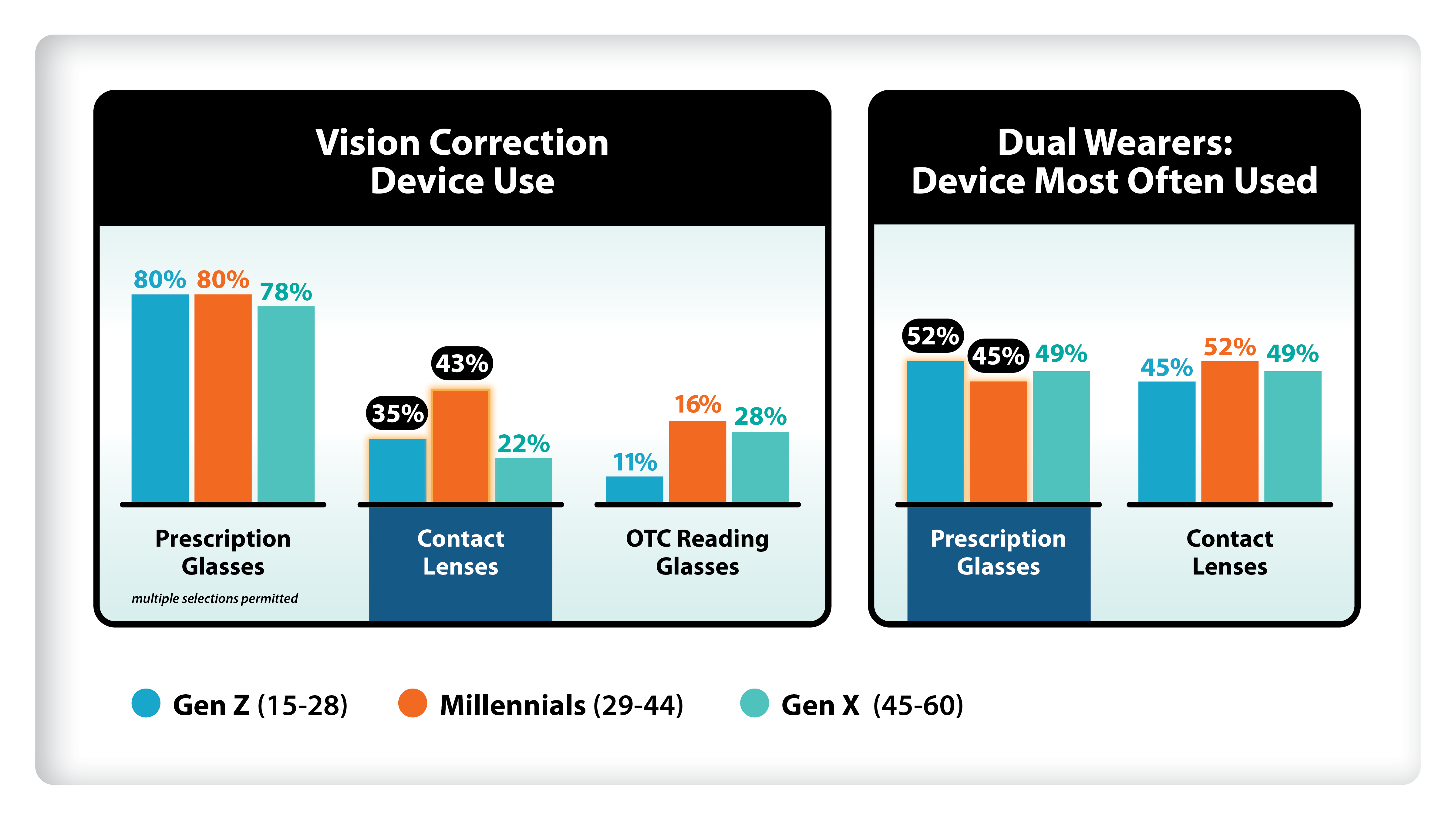
More striking is the comparison between younger generations. Despite growing up in a digital-first, innovation-driven environment, Gen Z is 8% less likely to wear contact lenses than Millennials. Among dual wearers, Gen Z also reports using glasses more frequently than contact lenses, signaling a shift in how younger patients perceive eyewear as part of identity and lifestyle rather than a compromise.
Why Patients Choose Contact Lenses
The reasons patients give for wearing contact lenses vary sharply by generation, and those differences carry meaningful implications for practice conversations.
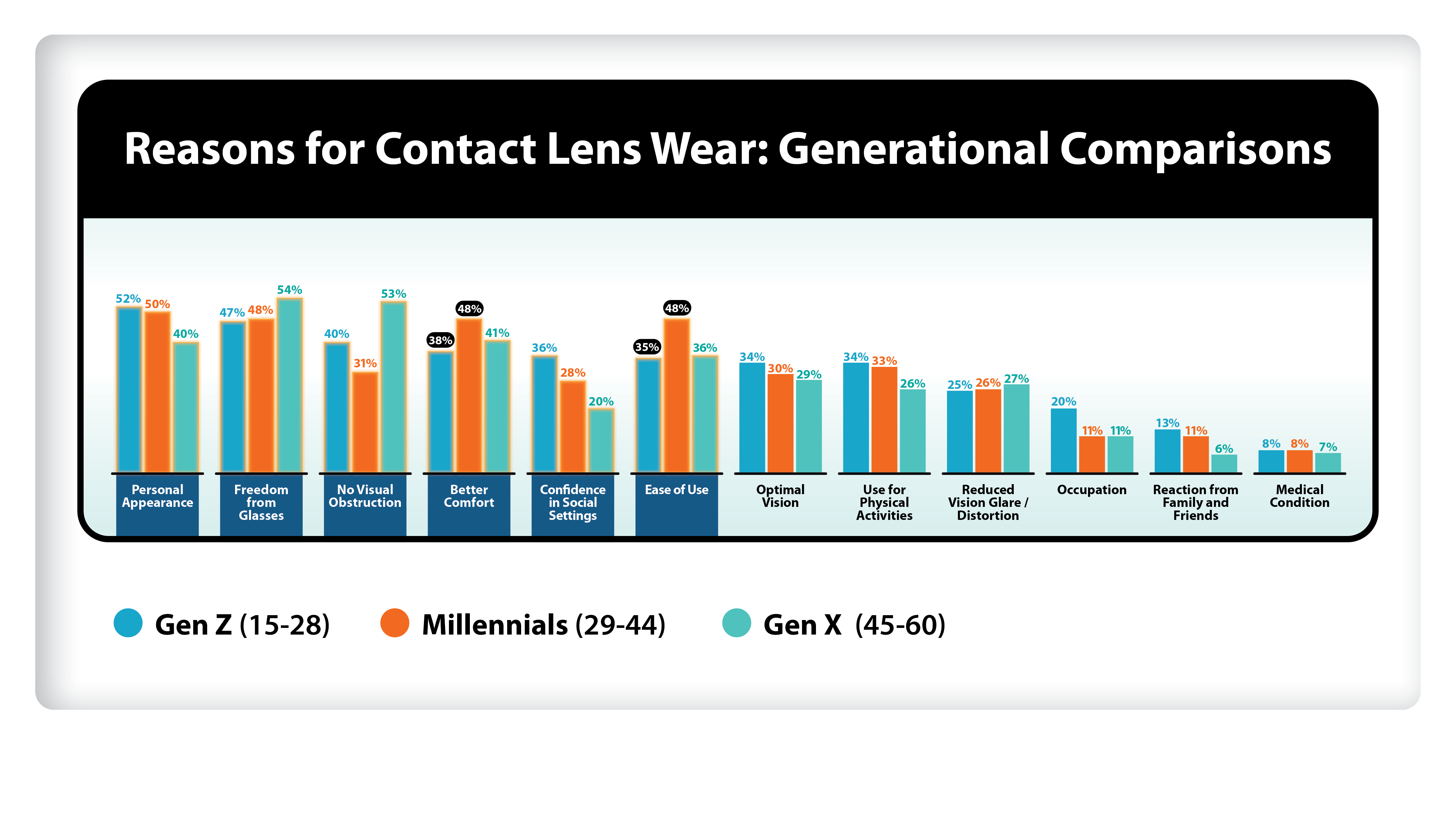
For Gen Z and Millennials, personal appearance ranks as the top motivator. More than half of Gen Z respondents cite appearance as their primary reason for wearing contact lenses, followed closely by freedom from glasses and the absence of visual obstruction. In contrast, Gen X places far greater emphasis on functional benefits such as comfort, convenience, and visual clarity, with appearance ranking much lower.
This distinction challenges a long-standing clinical assumption: that optimal vision is the primary driver of contact lens adoption. In fact, the study shows that across all cohorts, vision quality ranks only mid-range among reasons for choosing contact lenses. Lifestyle, identity, and practicality often matter more.
For practices, this underscores the importance of reframing conversations. Positioning contact lenses solely as a refractive solution will certainly miss the emotional and lifestyle motivations that truly influence patient decisions.
Technology: A Stronger Pull for Younger Patients
Advancements in contact lens technology resonate most strongly with Gen Z and Millennials. Features such as UV protection, reusable lens options, toric designs, and lenses optimized for extended wear use all score significantly higher with younger cohorts than with Gen X.
Interestingly, even multifocal lenses for presbyopia, arguably most relevant to Gen X, receive lower enthusiasm from that group than from Millennials. This suggests that older patients may not necessarily associate newer lens technologies with personal benefit, highlighting a potential gap in patient education rather than product relevance.
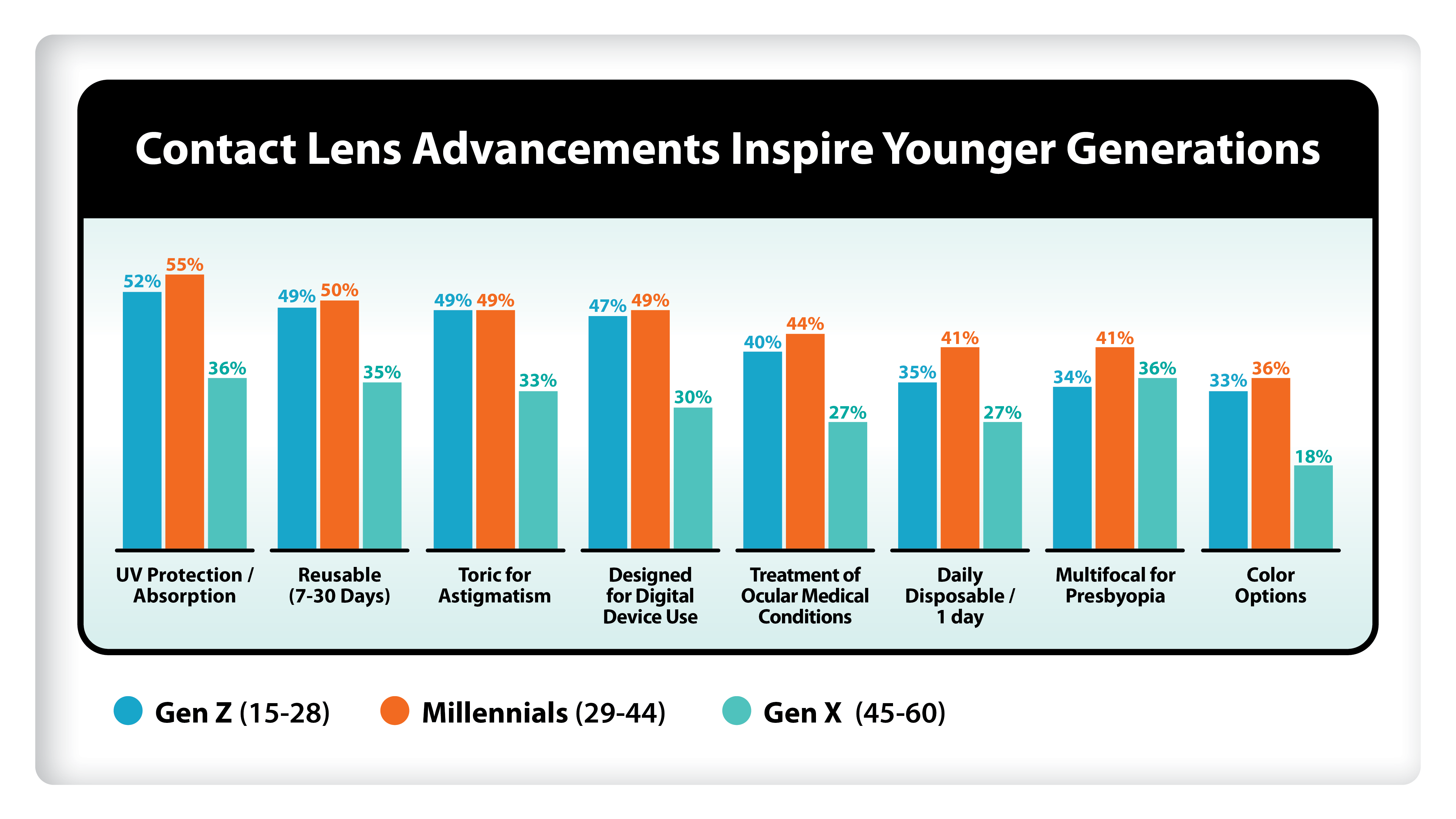
For younger patients, innovation itself carries symbolic value. Technology signals progress, personalization, and alignment with modern lifestyles. Practices that actively introduce and explain new lens options may find greater engagement among Gen Z and Millennial patients who are already predisposed to value innovation.
Values Drive Purchasing Decisions
Across all generations, three practical considerations dominate purchasing decisions: affordability, convenience, and speed of access. Nearly 90% of respondents cite value for money as their top driver, followed closely by ease of purchase and rapid product availability.
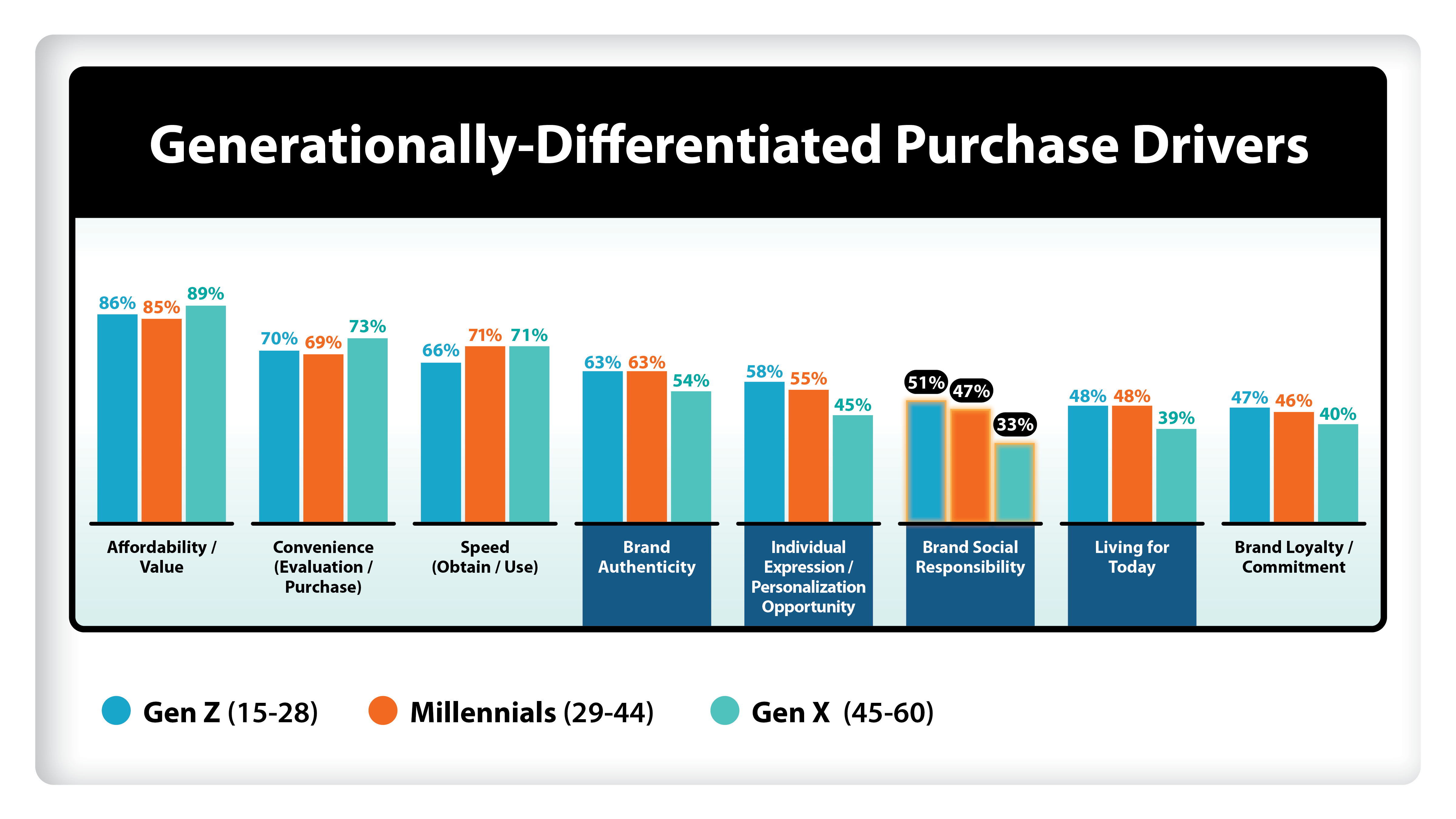
Beyond these universal priorities, generational differences emerge. Brand authenticity, individual expression, and social responsibility matter significantly more to Gen Z and Millennials than to Gen X. Younger patients want to feel that their choices reflect who they are and what they stand for, while older patients prioritize trust, clarity, and tangible value.
Interestingly, when it comes to interactions with eye care professionals and staff, Gen X places the highest importance on authenticity. This suggests that while brand messaging may resonate more with younger cohorts, personal, straightforward communication remains critical for older patients.
What This Means for Practice Strategy
The study’s findings reinforce a simple but powerful idea: one-size-fits-all communication no longer works.
For Gen Z, contact lens discussions should focus on self-expression, lifestyle fit, and innovation. Emphasizing how lenses support individuality, integrate with digital habits, and align with broader social values can help bridge the current gap in contact lens adoption.
Millennials, already the most engaged wearers, benefit from conversations that address comfort, ease of use, and evolving needs. As this cohort approaches presbyopia, proactive education about multifocal and specialty lens options becomes increasingly important.
For Gen X, success lies in authenticity and practicality. Clear explanations, functional benefits, and transparent value propositions are more likely to resonate than technology-driven messaging.
Across all age groups, the study highlights the importance of extending contact lens conversations beyond the exam room. Efficient ordering systems, fast turnaround times, and well-trained staff all play a role in reinforcing perceived value and convenience.
Looking Ahead
Roughly one in six individuals in North America currently wear contact lenses. While that number has remained relatively stable, this research suggests that growth opportunities still exist—particularly among younger patients whose values and motivations differ from those of older generations.
Understanding generational preferences allows eye care professionals to move beyond clinical assumptions and engage patients on a more personal level. By aligning recommendations with lifestyle goals, social values, and practical concerns, practices can strengthen patient relationships, improve satisfaction, and support long-term contact lens retention.
In an increasingly competitive and patient-driven market, listening closely to what different generations value may be just as important as the next technological breakthrough.

Dr. Jennifer Liao, OD, FAAO, FSLS
Jennifer Liao, OD, FAAO, FSLS is an associate professor of optometry, attending optometrist, and residency director of the Cornea and Contact Lenses Residency program at the New England College of Optometry. She is the lead instructor of the main contact lenses course and directs cornea and contact lens–focused clinical training with expertise in advanced contact lenses, dry eye management, and myopia control.