


You know that feeling. It’s the end of a grueling day of back-to-back refractions, and you’ve just finished with a particularly challenging patient. You sit down at your computer, exhausted and perhaps a bit annoyed. In that high-pressure moment, your Electronic Medical Record (EMR) often becomes an unintended outlet for your stress.
It is incredibly easy for your internal state, whether it’s frustration or pure exhaustion, to “leak” into your documentation. But we live in an era where patients have immediate legal access to every word you type. Because of this, your ability to pivot from an emotional reaction to a neutral, EQ-informed observation isn’t just a nice “soft skill”, it’s a professional necessity.
The Trap of “Emotional Leakage”
Emotional Intelligence (EQ) starts with your own self-awareness. In the context of note-writing, this means catching yourself when your current mood is steering your keyboard. When you’re frustrated, your notes tend to shift from objective observations to subjective judgments.
Keep an eye out for these “red flag” words that signal emotional leakage:
- “Difficult”
- “Uncooperative”
- “Demanding”
These terms don’t actually provide clinical value; they just serve as a digital “vent.” The real danger is the Bias Echo. These labels can follow a patient indefinitely, creating a cycle where every technician or specialist who sees that chart next approaches the patient with the same preconceived frustration you felt.
The Legal Reality: Your Patient is Reading
The medical record has evolved. It’s no longer a private, “behind-the-scenes” dialogue between professionals; it is a shared document. Thanks to patient portals, your patients can—and do—read your notes.
Imagine a patient reading a note that characterizes their behavior as “aggressive” or “hostile.” If they were acting out because they were terrified of losing their vision or didn’t understand the procedure, reading those words can be traumatizing. Once that therapeutic alliance is fractured by a poorly worded note, the professional repercussions are real. A note written in a moment of pique can quickly become primary evidence of perceived bias.
Your New Skill: Neutral Reframing
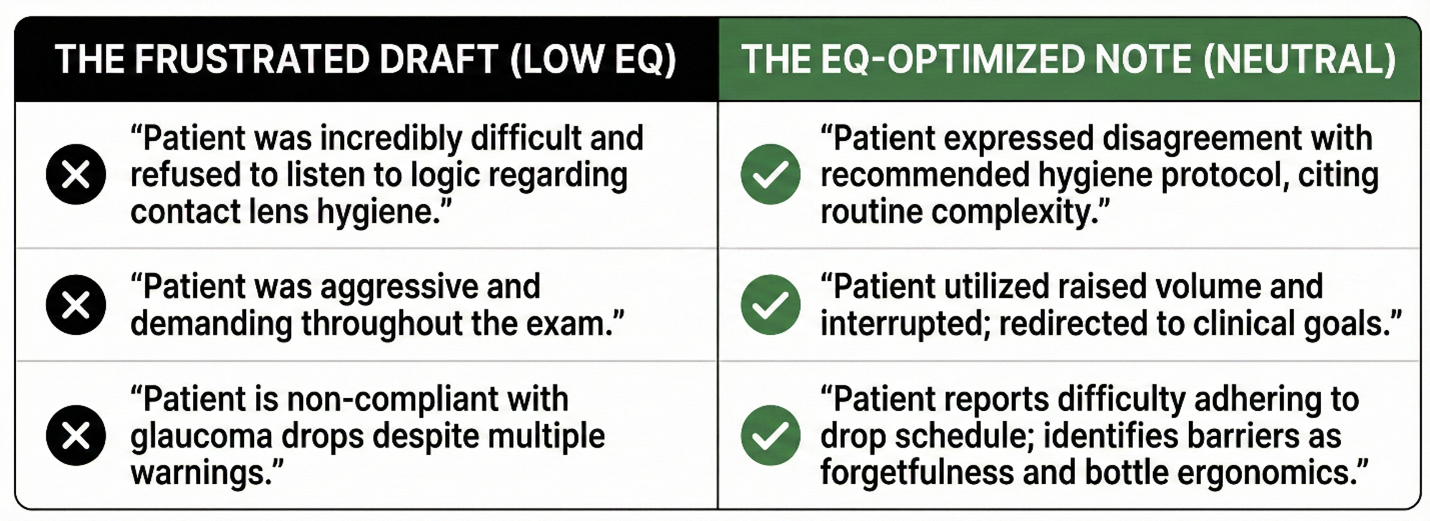
The core EQ skill you need to master is Neutral Reframing. This is the process of taking the “raw data” of a frustrating interaction and stripping away the emotional adjectives to reveal the clinical facts. You aren’t omitting what happened; you are describing it with such objectivity that the behavior speaks for itself.
Restoring Relational Clarity
When you choose neutral language, you achieve Relational Clarity. You are documenting the truth of the encounter while protecting your professional integrity. Most importantly, you are leaving the door open for a successful interaction next time. A neutral note gives the next professional a baseline to solve the problem (like improving drop ergonomics) rather than just bracing themselves to manage a “difficult” person.
Documentation as a Human Skill
Your success in eye care is increasingly defined by your human skills. High-EQ record keeping is an act of discipline. It requires you to pause, acknowledge your own frustration, and choose a narrative that serves both the patient’s health and your own career longevity. Feelings are temporary, but the record is permanent.
Is Your Team Prepared for the “Open Notes” Era?
Mastering neutral, high-EQ record keeping is essential for protecting your practice and fostering patient trust. I help eye care professionals and team leaders build the relational clarity needed to thrive in high-pressure environments.
Learn more at: www.emotionalintelligenceconsultinginc.com

Jade Bodzasy
Jade Bodzasy, Founder of Emotional Intelligence Consulting Inc., is a dedicated Coach and Consultant for Optometric Practices. Her extensive background includes over 20,000 hours of expertise focused on customer relations, work structure refinement, training method development, and fostering improved work culture within Optometric practices.
Certified in Rational Emotive Behavior Techniques (REBT), Jade possesses a unique skillset that empowers individuals to gain profound insights into the origins of their behaviors, as well as those of others. Leveraging her certification, she equips optometry practices with invaluable resources and expert guidance to establish and sustain a positive, healthful, and productive work environment.