


In a world supported by technology at every corner, our lifestyles demand more from our eyes and vision. Since 2019, adults spend over 30% more time engaging with digital devices, averaging 13.5 hours of screen time a day.5 This notable increase is likely, in part, due to a shift to remote and hybrid working, which often is associated with more video teleconferencing, but many turn to using smartphones or tablets to complete day-to-day tasks or entertainment outside of a working day. A 2023 survey found that an average US household has 21 digital devices and 13 different types of devices.6 Symptoms of ocular and visual discomfort due to our digital environments are well documented, arising from altered blink patterns,7 tear film changes,8 and accommodative and convergence demands.9
End-of-day comfort and vision play key roles in overall contact lens satisfaction.10 Contact lens wearers can experience fluctuating vision throughout the day, and many patients have difficulties with the visual requirements of driving at night.11

For presbyopes, navigating the inevitable gradual decline in accommodation, coupled with the intense demands of the day brings a further visual challenge. The aging eye is also more likely to exhibit reduced tear film stability1 and increased intraocular light scattering,2,3 in addition to increased refractive astigmatism.4,12
Contact lens technologies to support success in the presbyopic patient
Amongst contact lens wearers aged over 40, 90% expect to continue to wear contact lenses.13 Despite this, almost half of patients aged over 45 drop out of contact lens wear.13 However, with 46% of presbyopic contact lens wearers fitted with a non-presbyopic fit,14 a large proportion of presbyopic contact lens wearers experience a high level of compromise, requiring the use of reading glasses over their contact lenses.14
Most spherical multifocal contact lens fitting guides recommend fitting patients with 0.75D of astigmatism or less. However, eye care professionals are likely to encounter many presbyopes with more than 0.75D of astigmatism. Data shows that prevalence of refractive astigmatism of 0.50D to 1.75D increases with age (Figure 1).4 Further, while with-the-rule (WTR) astigmatism is more prevalent in younger age, there is a gradual shift to against-the-rule (ATR) astigmatism amongst presbyopes.12
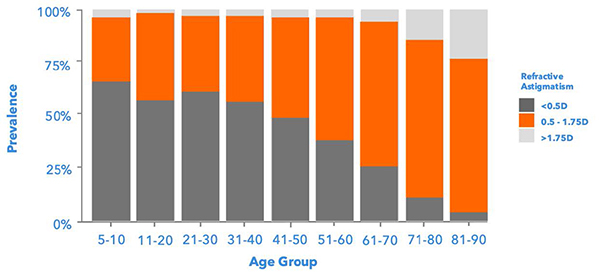
Figure 1: Prevalence of refractive astigmatism across age groups.4
Johnson & Johnson brings innovation to market to better serve presbyopic astigmatic patients
Up until now, daily disposable toric contact lens wearers have had to compromise as they become presbyopic.
Now, from the family of ACUVUE® OASYS MAX 1-Day comes ACUVUE® OASYS MAX 1-Day MULTIFOCAL for ASTIGMATISM, which combines innovative technologies from the ACUVUE® multifocal and toric lens designs with the performance of MAX for your presbyopic astigmatic patients.*15
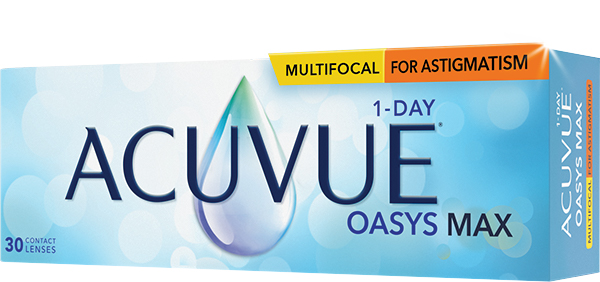
This lens features an innovative 1.00D cylinder lens designed to simplify lens selection while delivering consistent results for patients with 1.00D to 1.75D cylinder to provide coverage for over 70% of presbyopic astigmatic eyes with ≥1.00D cylinder. ‡16,17
In a clinical study, average visual acuity with ACUVUE® OASYS MAX 1-Day MULTIFOCAL for ASTIGMATISM was better than 20/20 at distance and intermediate and better than 20/25+ at near for subjects with 1.00 to 1.75D cylinder. ‡17 Further, there was no clinically significant difference between patients who had 1.75D cylinder and those who had 1.00-1.50D cylinder for visual acuity, subjective comfort, subjective vision or subjective handling scores.^17 Wearers of ACUVUE® OASYS MAX 1-Day MULTIFOCAL for ASTIGMATISM confidently report clear vision reading a cell phone and using a computer.§17
Find out more about the FIRST and ONLY daily disposable multifocal toric contact lens18
Authors: Meredith Bishop OD MS FAAO, Senior Manager Global Professional Education and Development at Johnson & Johnson Vision Care, Inc. David Ruston BSc FCOptom DipCLP FAAO, Director Global Professional Education and Development at Johnson & Johnson Medical Ltd.
This Post is sponsored by Johnson & Johnson.
*Versus Dailies Total1®
‡In a clinical study of 163 subjects including 34 subjects with 1.75 D cyl in at least one eye. Average descriptive values.
^In a clinical study of 164 subjects including 34 subjects with 1.75 D cyl in at least one eye. Average descriptive values. No clinically significant difference (visual acuity:≤2.5 letters, comfort and handling:≤5 points on validated questionnaire).
- T3B descriptive summaries: n=171
References
- Mostafa YMSE, Saif MYS, Saeed MA, et al. The Effect of Age and Gender on Tear Film Breakup Time. Egyptian Journal of Medical Research 2021;2(2):137–48.
- van den Berg TJ. Analysis of intraocular straylight, especially in relation to age. Optom Vis Sci 1995;72(2):52–9.
- van den Berg TJTP, Van Rijn LJR, Michael R, et al. Straylight Effects with Aging and Lens Extraction. American Journal of Ophthalmology 2007;144(3):358-363.e1.
- Sanfilippo PG, Yazar S, Kearns L, et al. Distribution of astigmatism as a function of age in an Australian population. Acta Ophthalmol 2015;93(5):e377–85.
- Eyesafe. COVID-19: Screen Time spikes to over 13 hours per day according to Eyesafe Nielsen estimates. Eyesafe March 2020.
- Deloitte. Balancing act: Seeking just the right amount of digital for a happy, healthy connected life. Deloitte Insights. https://www2.deloitte.com/us/en/insights/industry/telecommunications/connectivity-mobile-trends-survey/2023/connectivity-mobile-trends-survey-full-report.html. Accessed December 13, 2024.
- Portello JK, Rosenfield M, Chu CA. Blink rate, incomplete blinks and computer vision syndrome. Optom Vis Sci 2013;90(5):482–7.
- Wolffsohn JS, Lingham G, Downie LE, et al. TFOS Lifestyle: Impact of the digital environment on the ocular surface. Ocul Surf 2023;28:213–52.
- Watten RG, Lie I, Birketvedt O. The influence of long-term visual near-work on accommodation and vergence: a field study. Journal of human ergology 1994;23(1):27–39.
- Diec J, Naduvilath T, Tilia D. Subjective Ratings and Satisfaction in Contact Lens Wear. Optom Vis Sci 2018;95(3):256–63.
- Nicole Gruber, Urs P. Mosimann, René M. Müri & Tobias Nef (2013) Vision and Night Driving Abilities of Elderly Drivers, Traffic Injury Prevention, 14:5, 477-485, DOI: 10.1080/15389588.2012.727510.
- Read SA, Vincent SJ, Collins MJ. The visual and functional impacts of astigmatism and its clinical management. Ophthalmic Physiol Opt 2014;34(3):267–94.
- JJV Data on File 2022. A survey conducted with a total n=7356 and CL wearers n=1213 representative U.S. and U.K. consumers, ages 15-64.
- Morgan PB, Efron N, Papas E, et al. BCLA CLEAR Presbyopia: Management with contact lenses and spectacles. Contact Lens and Anterior Eye 2024;47(4):102158.
- JJV Data on File 2022. Comparative Subjective Claims for ACUVUE® OASYS MAX 1-Day lens vs Dailies Total1® and Additional Stand-Alone Claims.
16. JJV Data on File 2024. SKU Coverage Claims for ACUVUE® OASYS MAX 1-Day and ACUVUE® OASYS MAX 1-Day MULTIFOCAL Brand Contact Lenses.
17. JJV Data on File 2024. Subjective Standalone Claims for ACUVUE® OASYS MAX 1-Day MULTIFOCAL Contact Lenses for ASTIGMATISM.
18. JJV Data on File 2024, First and Only Daily Disposable Multifocal Toric Contact Lens in US.
Important Safety Information: ACUVUE® Contact Lenses are indicated for vision correction. As with any contact lens, eye problems, including corneal ulcers, can develop. Some wearers may experience mild irritation, itching or discomfort. Lenses should not be prescribed if patients have any eye infection, or experience eye discomfort, excessive tearing, vision changes, redness or other eye problems. Consult the package insert for complete information. Complete information is also available from Johnson & Johnson Vision Care, Inc. by calling 1-800-267-5098, or by visiting www.jnjvisionpro.com/en-ca/.
The third-party trademarks used herein are the intellectual property of their respective owners.
© Johnson & Johnson and its affiliates 2025 2025PP15604