

three ODs signing a contract Roxanne Arnal sept 2026 ECBC article

Whether you’re entering a partnership, signing a shareholders’ agreement, or setting up a joint venture, shared ownership is becoming more common in optometry. It can give you access to capital, support your succession plans, and spread out the responsibilities of running the practice. But the real test of these arrangements is not how they begin, it’s how well they adapt when circumstances change.

Most ownership arrangements are put in place when everyone is aligned and optimistic about the future. The real value of a formal agreement shows up later, when circumstances change in ways no one expected.

Ownership vs. Control

One of the first questions to clarify is whether your ownership percentage actually gives you the decision-making authority you expect.

Your agreement may set different voting requirements for major decisions. Expanding the practice, bringing in a new owner, taking on significant debt, or selling the business may require more than a simple majority and, in some cases, everyone may need to agree.

Getting clear on these issues early can prevent disagreements later, especially when the real problem is simply that each owner has different expectations.

Planning for Life Events

Careers rarely unfold exactly as planned. Someone may want to reduce their clinical hours, retire earlier than expected, or step back because of a health challenge.

Before you sign, or at your next agreement review, make sure you can answer questions such as:

  • What happens if you or another owner wants to leave?
  • How will a prolonged disability be handled?
  • Can someone keep their ownership interest if their clinical involvement changes?
  • What happens when an owner retires or dies?

These conversations may feel uncomfortable, but they are much easier to have before a situation happens.

Valuation Matters

If an owner wants, or needs to sell, agreeing on a fair price can become surprisingly contentious. Your practice may have significant goodwill, growth potential, and future earning capacity that each owner may value differently.

For this reason, your agreement should set out a valuation process in advance. Whether you update the value regularly, use a formula or bring in an independent third party when needed, a defined process can reduce uncertainty when an owner leaves.

Contributions Change Over Time

Over time, the way each owner contributes will likely change. One person may take on more management responsibility while another elects to focus primarily on patient care.

As those responsibilities shift, a compensation structure that once felt fair may no longer feel that way.

Review expectations, workload, and compensation regularly. This helps keep the arrangement aligned with how the practice operates today and not just how it operated when the agreement was first signed.

A Business Relationship Deserves Business Planning

Most shared-ownership arrangements begin with trust, mutual respect, and a common vision. A formal agreement does not replace these qualities but rather provides a framework for working through the uncertainty that comes with owning a practice together.

As an optometrist, your practice is often both your career and one of your most significant financial assets. Whether you own it through a partnership, corporation, or joint venture, a clear agreement can help protect your business, your investment, and the relationships behind it.

The best time to work through these difficult questions is before you are facing a difficult situation.

You cannot eliminate every uncertainty. But with the right framework in place, you can face change with greater clarity, confidence, and control all while treating each owner fairly.


Have more questions? We’re here to help.

Roxanne Arnal is a Certified Financial Planner®, Chartered Life Underwriter®, Certified Health Insurance Specialist, former optometrist, Professional Corporation President, and practice owner. She is dedicated to empowering individuals and their wealth by helping them make smart financial decisions that bring more joy to their lives.

This article is for information purposes only and is not a replacement for personalized financial planning or legal advice. Errors and omissions excepted.




Share:
Rate:

0 / 5. 0

Check list photo for ROI article

Yes, another checklist for your summer planning session. This stuff matters. A lot! Get it together, along with last week’s checklists, and you will be a top-value practice owner.

Essential/Critical Items

  • Proper, Written Associate and Employee Contracts
  • Premises Lease, Renewal and Assignment Options
  • Bank-Approved Professional Appraisal
  • Professional Incorporation and Minute Book Compliance
  • Clinical Services and Procedures Analysis
  • Active Patient Count, Complete with Demographics
  • Performance Data by Practitioner, per Hour/Day/Month
  • Accounts Receivable: Fully Reconciled and Purified

HOW DO I GET STARTED?

  • Assemble a team of professionals who have dealt with numerous optometric practice transitions.
  • Understand when and why each transition item should be introduced during the selling process. There is a strategic path to follow to ensure the integrity of your goodwill is maintained at all times.
  • Every transition is unique. Your broker will help you understand the many other transition items that will be added to your customized checklist.
  • Your ROI Broker will provide a transition manual explaining the dozens of minor business issues that will be transferred to the new owner and guide you through the many steps in the process, such as how, what and when to tell staff and patients.


Jackie Joachim

JACKIE JOACHIM

Jackie Joachim graduated from the University of Toronto with a Bachelor of Arts degree in Economics and Political Science and has close to 30 years of experience in the health care sector. She began her career in banking where she learned how to finance health care practices. With 10 years of experience in practice management, she developed and delivered seminars to healthcare professionals across the country, coached hundreds of practitioners for planning, marketing, patient education, human resources and financial management. She has been a keynote speaker at both national and provincial association conventions where she has had the privilege of speaking with thousands of health care professionals across Canada.  You can reach at  Jackie.joachim@roicorp.com or 1-844-764-2020.


Share:
Rate:

0 / 5. 0

Roxanne Arnal ECBC Understanding Capital Gains Inclusion Rates, the LCGE, and Capital Losses

For many optometrists, much of their financial planning focuses on practice growth, long-term investing, and retirement preparation. Yet some of the most significant tax consequences arise when an investment, business asset, or practice interest is sold.

Understanding how capital gains, capital losses, and available exemptions are treated can provide valuable context when making major financial decisions.

What Is a Capital Gain?

A capital gain occurs when an asset is sold for more than its adjusted cost base. Common examples include investments held in a non-registered account, real estate that is not a principal residence, or shares of a private corporation, such as your practice.

For example, if an investment was purchased for $100,000 and later sold for $150,000, the capital gain would be $50,000.

Unlike employment or professional income, only a portion of a capital gain is taxable.

Understanding the Capital Gains Inclusion Rate

As of 2026, the capital gains inclusion rate remains at 50%.

This means that only half of a realized capital gain is included in taxable income. Using the previous example, a $50,000 gain would result in $25,000 of taxable income.

While the inclusion rate has changed several times throughout Canadian tax history, capital gains continue to receive preferential tax treatment compared to employment or professional income.

Why Capital Gains Matter for Optometrists

An optometrist may realize capital gains through:

  • The sale of shares of an incorporated practice
  • The sale of investments held outside registered accounts
  • The transfer of certain business assets
  • The disposition of recreational or investment real estate

Since practice value often represents a significant portion of an optometrist’s net worth, understanding the tax implications of a future sale becomes increasingly important as retirement approaches.

The Lifetime Capital Gains Exemption (LCGE)

One of the most valuable tax provisions available to Canadian business owners is the Lifetime Capital Gains Exemption (LCGE).

The LCGE allows eligible individuals to shelter a significant portion of capital gains realized on the sale of qualified small business corporation shares. The exemption was increased to $1.25 million, with the limit indexed to inflation beginning in 2026.

When available, the LCGE can significantly reduce or even eliminate tax on a portion of the gain realized on the sale of a professional corporation.

However, eligibility requirements are detailed and must be satisfied both at the time of sale and throughout the 24 months leading up to the transaction.

Key tests must be met regarding:

  • The nature of the corporation’s assets
  • The ownership of the shares
  • The active business use of corporate assets

Seemingly minor issues, such as excess passive investments and permanent life insurance policies accumulating inside a corporation, can sometimes affect eligibility. As a result, corporate structures should be reviewed well before a planned sale to preserve eligibility for the exemption.

What Happens When Investments Decline? Understanding Capital Losses

Not every investment produces a gain.

When an asset is sold for less than its adjusted cost base, the resulting loss is known as a capital loss.

Capital losses generally cannot be used to reduce employment income, professional income, or other ordinary sources of earnings, but rather are applied against taxable capital gains.

This creates several planning opportunities.

A capital loss may be used to:

  • Offset taxable capital gains realized in the current year
  • Carry back against taxable capital gains from any of the previous three taxation years
  • Carry forward indefinitely to offset future taxable capital gains

This flexibility can be valuable during periods of market volatility, particularly when gains and losses exist across different holdings.

Looking Beyond the Tax Result

Although tax considerations are important, they are only one part of a larger financial picture that may include retirement planning, liquidity needs, risk management, and estate objectives.

Tax on a capital gain is often the result of a successful investment outcome.

Conversely, realizing a loss solely for tax reasons may not improve long-term financial results if the investment strategy itself no longer aligns with broader objectives.

For optometrists who already have significant exposure to a single business asset through their practice, this balanced perspective can be particularly valuable. The tax treatment of gains and losses matters, but so does maintaining an investment portfolio that supports diversification and long-term financial stability.

A Useful Framework

Capital gains rules influence investment decisions, business succession planning, and retirement outcomes throughout an optometrist’s career.

The inclusion rate determines how gains are taxed, the LCGE may provide significant relief on the sale of qualifying practice shares, and capital losses can help offset gains when investment results are uneven.

Understanding how these rules work provides a stronger foundation for making informed financial decisions over time.

Have more questions? We’re here to help.

Roxanne Arnal is a Certified Financial Planner®, Chartered Life Underwriter®, Certified Health Insurance Specialist, former optometrist, Professional Corporation President, and practice owner. She is dedicated to empowering individuals and their wealth by helping them make smart financial decisions that bring more joy to their lives.

This article is for information purposes only and is not a replacement for personalized financial planning. Errors and omissions excepted.



ROXANNE ARNAL,

Optometrist and Certified Financial Planner

Roxanne Arnal graduated from UW School of Optometry in 1995 and is a past-president of the Alberta Association of Optometrists (AAO) and the Canadian Association of Optometry Students (CAOS). She subsequently built a thriving optometric practice in rural Alberta.

Roxanne took the decision in 2012 to leave optometry and become a financial planning professional. She now focuses on providing services to Optometrists with a plan to parlay her unique expertise to help optometric practices and their families across the country meet their goals through astute financial planning and decision making.


Share:
Rate:

5 / 5. 1

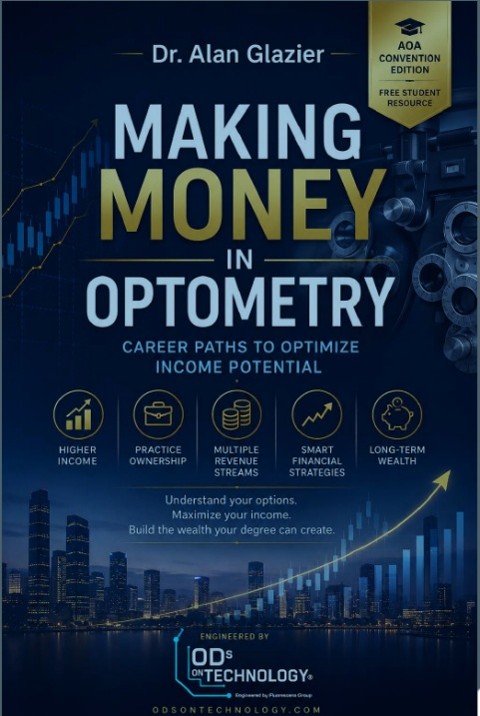
Making Money in Optometry

For many optometry students and early-career ODs, the clinical path is clearly marked. The business path is often less obvious.

Which first job makes sense? When is practice ownership worth considering? How should a new graduate think about student debt, equipment investment, associate roles, specialty services, or eventual ownership? What are the trade-offs between income, autonomy, risk and lifestyle?

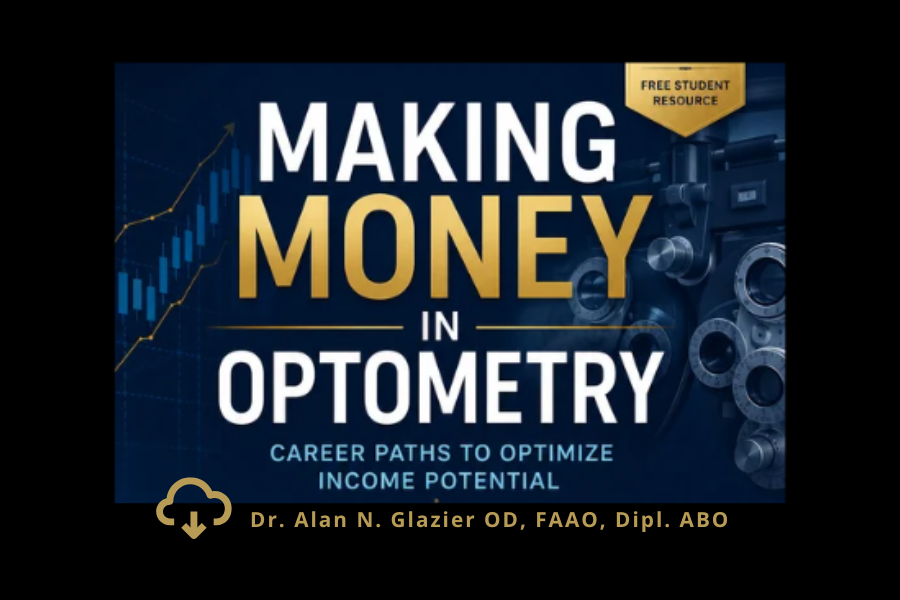
These are the kinds of questions explored in Making Money in Optometry: Career Paths to Optimize Income Potential, a new book by Dr. Alan Glazier, founder of ODs on Facebook. The book is now available as a free download.

While the title is direct, the underlying message is practical: career outcomes are shaped by real decisions.

“ This book is written for optometry students and young optometrists who are not financially sophisticated. You don’t need a finance background to read it. You need only a willingness to absorb new information and think a little more deliberately about the choices in front of you than most of your colleagues will.”

Dr. Alan Glazier, OD, FAAO

A Plain-Language Look at the Business Side of Optometry

Dr. Glazier frames the book around a gap many optometrists will recognize: clinical training is extensive, but the business and financial mechanics of a career in optometry are not always taught in the same structured way.

Download Free Ebook Now

The book begins by asking readers to think more deliberately about what they are trying to build. Is it practice ownership, financial independence, a highly specialized clinical niche, more flexibility, a strong associate career, or a balanced professional life?

The point is not that every OD should pursue the same destination, but that career choices become clearer when they are made with a defined purpose.

From there, the book moves into the decisions that shape income and opportunity: different practice settings, ownership models, the role of debt, investment in equipment, delegation, specialty care, real estate, consulting, industry work and long-term saving.

Career Paths, Trade-Offs and Ownership Models

One of the book’s central sections examines different optometric career paths and their relative earning potential. These include academic roles, retail and corporate settings, independent practice associate positions, hospital and health-system roles, non-clinical industry positions, corporate leaseholder arrangements and independent ownership.

Making Money in Optometry The tone is direct, but the message is broader than compensation alone. Each path carries its own mix of income potential, risk, autonomy, schedule expectations, benefits, business responsibility and long-term opportunity.

For students and new graduates, this kind of comparison can be especially valuable. Early career choices are often made quickly, sometimes based on geography, salary, mentorship, debt pressure or the first attractive offer. Dr. Glazier encourages readers to look beyond the first contract and consider how each path may affect future flexibility and long-term goals.

The book also gives significant attention to practice ownership. It outlines three routes into independent practice: buying an existing practice, opening cold, and the less-discussed “practice within a practice” model. Each path is presented with its own risk profile, practical considerations and potential advantages.

Practical Decisions, Not Abstract Theory

A recurring theme throughout the book is that financial progress in optometry is often built through practical, incremental decisions.

That includes understanding the difference between gross and net income, knowing when to invest in revenue-producing equipment, building systems that allow delegation, considering specialty care opportunities, and recognizing that higher income does not automatically translate into long-term wealth.

Dr. Glazier also addresses side income opportunities that build on an OD’s professional expertise, such as key opinion leader work, consulting and clinical trials. His argument is not that every optometrist needs a side venture, but that an OD degree can create opportunities beyond the exam room when applied strategically.

The final section of the book focuses on the distinction between earning and building wealth. For younger ODs in particular, the message is straightforward: saving early, investing consistently and making disciplined financial choices may matter as much as choosing the highest-earning career path.

Why This May Resonate with Canadian Students and ODs

Although many of the book’s examples and compensation references are U.S.-based, the broader questions are highly relevant to Canadian optometry students and practitioners.

Canadian ODs face many of the same career decisions: whether to practice as an associate, pursue ownership, work within a corporate-affiliated model, or build a more specialized clinical niche.

They must also consider how to think about debt, when to invest in technology, how to evaluate different practice models, and how to balance professional ambition with lifestyle and personal goals.

Readers should, of course, interpret any financial figures, lending assumptions, taxation issues or regulatory considerations in the context of their own province and seek advice from qualified Canadian financial, legal and practice advisors where appropriate.

Still, the book’s central value lies in prompting better questions. What kind of career am I building? What decisions will increase my options? What risks am I prepared to take? What do I need to learn about the business side of practice before making a major move?

Download the Free Book

Making Money in Optometry is available now as a free download.

For optometry students, residents and new graduates, it offers a practical introduction to the career and business decisions that often arrive sooner than expected. For established ODs, it may serve as a useful prompt to revisit current assumptions and consider whether the next stage of practice should look different from the last.

This post is sponsored by Fluorescene Group


Share:
Rate:

0 / 5. 0